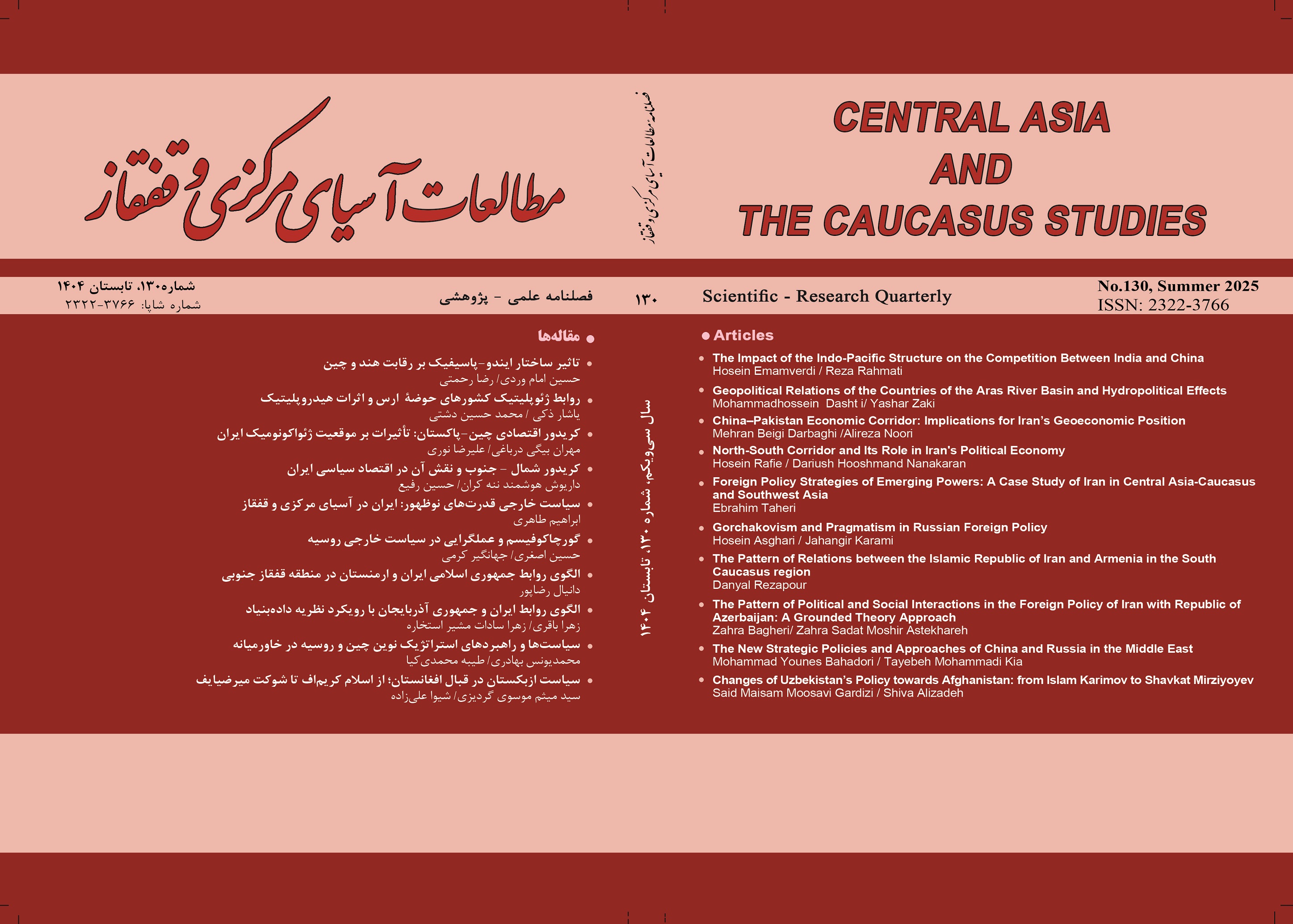
Emerging powers have been recognized as a new form of power in the international arena. In this regard, some countries, including Iran, can be considered as an emerging power. The research question is: What is the foreign policy strategy of emerging powers in general and the foreign policy strategy of Iran in the Central Asian- the South Caucasus, and Southwest Asia? The research results show that emerging powers mainly use strategies such as hard balancing, Band wagoning, hedging, Accommodation, appeasement, and soft balancing to achieve their goals. In case of Iran, it should be noted that this country is trying to block American hegemony in Central Asia, in the framework of a soft balancing strategy, with the support of Russia and China. In the South Caucasus, it uses a strategy of hedging and balancing from the outside to contain Türkiye and the Republic of Azerbaijan. this country uses different strategies in Southwest Asia and its various subregions. For example, in the Levant, a hard balancing act is being pursued to contain Israel and accommodation to contain Türkiye. In the Persian Gulf, it has used hedging to contain the UAE-Saudi Arabia axis. The aim of this research is to examine the foreign policy strategy of emerging powers, with an emphasis on the foreign policy strategy of the Islamic Republic of Iran in the two environments of Central Asia - Caucasus and Southwest Asia. The research method used is a theory-case matching and qualitative comparison method using a descriptive-analytical approach.
taheri, E. (2025). Foreign Policy Strategies of Emerging Powers: A Case Study of Iran in Central Asia-Caucasus and Southwest Asia. Central Asia and The Caucasus Journal, 31(130), 117-146. https://doi.org/10.22034/ca.2025.729394
MLA
taheri, E. "Foreign Policy Strategies of Emerging Powers: A Case Study of Iran in Central Asia-Caucasus and Southwest Asia", Central Asia and The Caucasus Journal, 31, 130, 2025, 117-146. doi: 10.22034/ca.2025.729394
HARVARD
taheri E. (2025). 'Foreign Policy Strategies of Emerging Powers: A Case Study of Iran in Central Asia-Caucasus and Southwest Asia', Central Asia and The Caucasus Journal, 31(130), pp. 117-146. doi: 10.22034/ca.2025.729394
CHICAGO
E. taheri, "Foreign Policy Strategies of Emerging Powers: A Case Study of Iran in Central Asia-Caucasus and Southwest Asia," Central Asia and The Caucasus Journal, 31 130 (2025): 117-146, doi: 10.22034/ca.2025.729394
VANCOUVER
taheri E. Foreign Policy Strategies of Emerging Powers: A Case Study of Iran in Central Asia-Caucasus and Southwest Asia. Central Asia and The Caucasus Journal. 2025;31(130):117-146 (In Persian). doi: 10.22034/ca.2025.729394