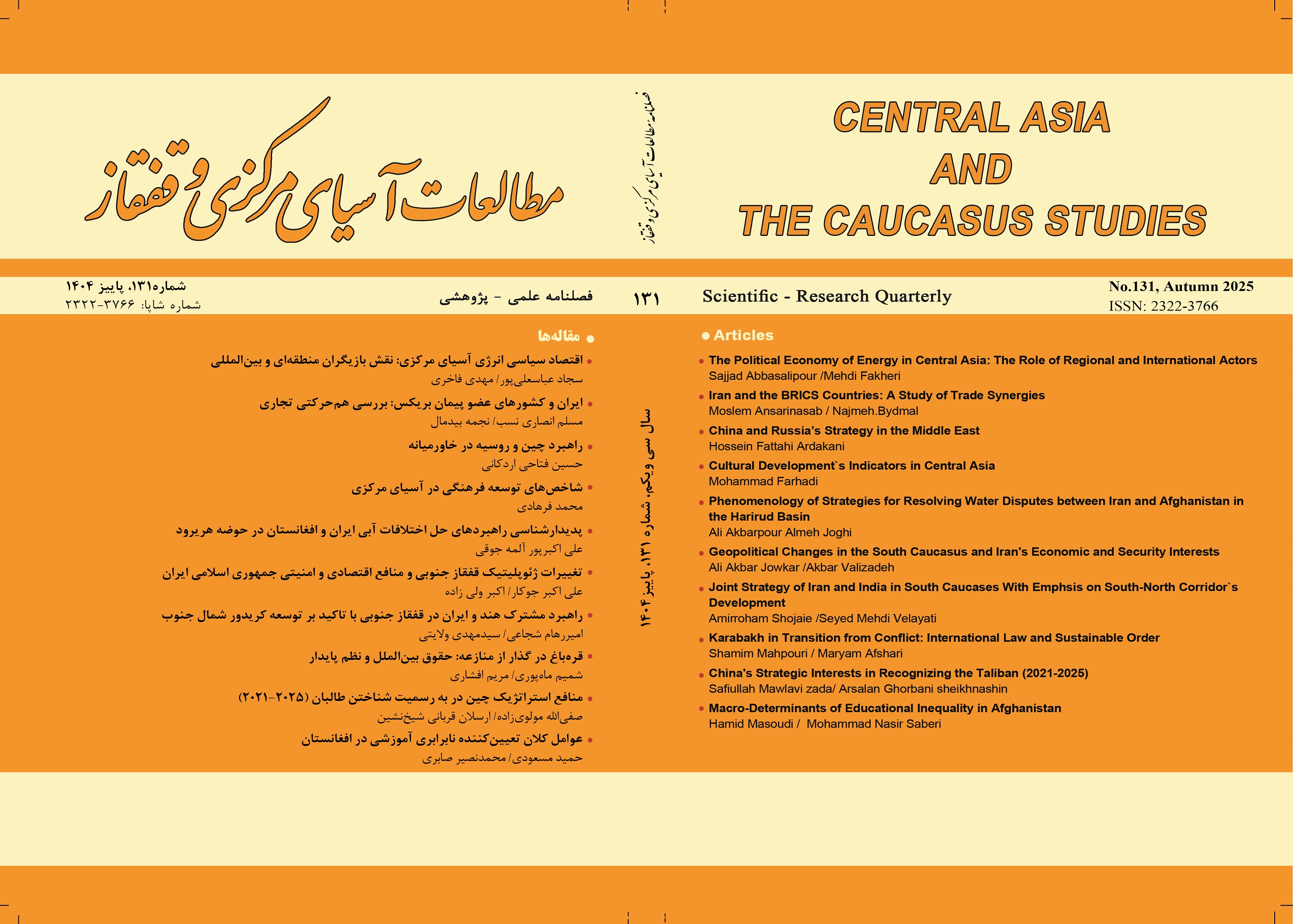
The present study aims to phenomenologically analyze the strategies for resolving water disputes between Iran and Afghanistan in the Harirud Basin. This study, using a qualitative approach and interpretive phenomenology method, examines the perceptions and experiences of experts in the fields of water, international relations, and the environment in 1403 to 1404. Sampling was purposefully conducted based on the principle of theoretical saturation, and a total of 20 in-depth semi-structured interviews were conducted with 20 people. The data were analyzed using grounded theory and three-stage coding (open, axial, and selective). The findings showed that the strategies for resolving water disputes between Iran and Afghanistan are categorized into 116 open codes and 11 main categories including “mutual benefits”, “formal and informal diplomacy”, “international institutions”, “education and empowerment”, “economic interactions”, “environmental issues”, “scientific and local synergy”, “executive will”, “cultural and social interactions”, “transparency” and “strategic document”. These categories were organized into seven general areas: political, social, cultural, economic, legal and environmental. The results of this study can help policymakers and decision-makers in responsible institutions to design sustainable solutions and reduce water tensions, especially in the Harirud basin.
Akbarpour Almeh Joghi,A . (2025). Phenomenology of Strategies for Resolving Water Disputes between Iran and Afghanistan in the Harirud Basin. Central Asia and The Caucasus Journal, 31(131), 113-138. doi: 10.22034/ca.2025.731853
MLA
Akbarpour Almeh Joghi,A . "Phenomenology of Strategies for Resolving Water Disputes between Iran and Afghanistan in the Harirud Basin", Central Asia and The Caucasus Journal, 31, 131, 2025, 113-138. doi: 10.22034/ca.2025.731853
HARVARD
Akbarpour Almeh Joghi A. (2025). 'Phenomenology of Strategies for Resolving Water Disputes between Iran and Afghanistan in the Harirud Basin', Central Asia and The Caucasus Journal, 31(131), pp. 113-138. doi: 10.22034/ca.2025.731853
CHICAGO
A Akbarpour Almeh Joghi, "Phenomenology of Strategies for Resolving Water Disputes between Iran and Afghanistan in the Harirud Basin," Central Asia and The Caucasus Journal, 31 131 (2025): 113-138, doi: 10.22034/ca.2025.731853
VANCOUVER
Akbarpour Almeh Joghi A. Phenomenology of Strategies for Resolving Water Disputes between Iran and Afghanistan in the Harirud Basin. Central Asia and The Caucasus Journal. 2025;31(131):113-138 (In Persian). doi: 10.22034/ca.2025.731853