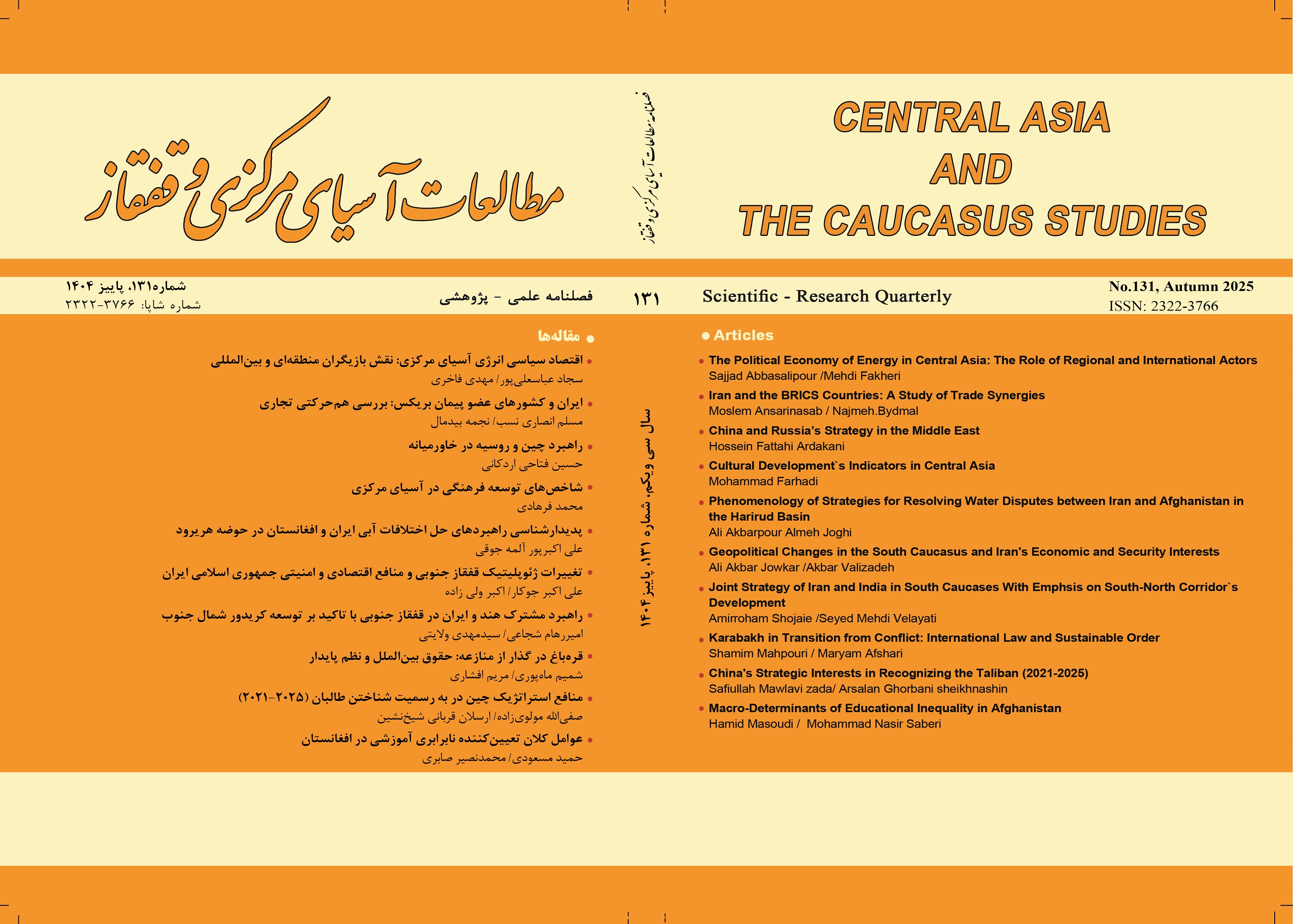
Volume & Issue: Volume 31, Issue 131, Autumn 2025, Pages 1-290 
Number of Articles: 13
The Political Economy of Central Asian Energy and the Role of Regional and International Actors

The Political Economy of Central Asian Energy and the Role of Regional and International Actors

Pages 3-34

https://doi.org/10.22034/ca.2025.731849

Sajjad Abbasalipour, Mehdi Fakheri

Abstract The presence of energy resources in Central Asia represents one of the most significant opportunities for the countries in the region to overcome economic and political crises following independence. The three Central Asian countries with fossil fuel reserves have, from the outset, sought to attract international investments to make the energy sector the central driver of their economic growth. This trend accelerated particularly with the rise in energy prices after the year 2000. Some scholars argue that the existence of these energy resources and the revenues generated from them have led to the formation of restricted and authoritarian political systems. However, others believe that the internal conditions of these countries are rooted in their history and political culture, and that without these resources, they would face even greater economic and political instability.On the other hand, the realist logic and intra-regional competition have been among the main obstacles to economic and energy cooperation within the region. This issue has typically been resolved when a regional or international power has acted as a facilitator and guarantor. International organizations and initiatives, such as the “Shanghai Energy Club” and “CAREC,” have been unable to effectively and broadly alter this realist logic, instead providing a platform for bilateral and trilateral cooperation among member countries. Examples of successful cooperation include China’s bilateral partnerships in gas with Turkmenistan and oil with Kazakhstan. China’s strategic approach in the Central Asian energy sector has aimed to reduce energy security challenges and create a balance against major powers, particularly Russia.

Iran and the BRICS member countries: A Study of Trade Synergies

Iran and the BRICS member countries: A Study of Trade Synergies

Pages 35-56

https://doi.org/10.22034/ca.2025.731850

Moslem Ansarinasab, najmeh bidmal

Abstract BRICS members have large economies, with fast growth and high influence on regional and global trade. Therefore, Iran's economy has a unique opportunity to join Iran and make optimal use of the high commercial capacities of this group. In this article, the index of trade similarity between Iran and BRICS members for the period of 2003-2022 was studied, and the results showed that Iran's trade similarity with China and India had the highest rate, followed by Iran's trade similarity with Russia, then Brazil, and finally Africa. South had the lowest commercial similarity rate. Also, the results of the bilateral export stability index of Iran's economy with the BRICS group indicate that Iran-India and Iran-Russia exports have enjoyed high stability in the last three decades. Also, the results of the stability index of bilateral trade of Iran's imports indicate that the imports of Iran-Brazil, Iran-Russia, Iran-India, Iran-China and Iran-South Africa have enjoyed high stability in the last three decades, respectively. On the other hand, the results of the co-movement index show that with Iran's membership in the BRICS group and the growth of Iran's trade with China, Iran's trade with other countries will be able to expand in line with it. the weak and strong points of trade with each of the five countries of the BRICS group extracted from the statistical analysis of this article, can be the road map of Iran's trade with the members be the BRICS group.

China and Russia’s Strategy in the Middle East

China and Russia’s Strategy in the Middle East

Pages 57-86

https://doi.org/10.22034/ca.2025.731851

Hossein Fattahi Ardakani

Abstract The Middle East has been of considerable importance in the strategy of international powers and plays an important role since the past. China and Russia, as two major international powers, are trying to create a multipolar order, and the Middle East is known as one of their strategic arenas of confrontation and cooperation. Their common goal is to expand their influence by actively shaping regional political and security dynamics to challenge the hegemony of the West and the United States. The present study, by applying a game theoretical framework and employing an explanatory method, seeks to answer the question of what is the strategy of China and Russia in the Middle East? The findings show that since strategies are a function of the tools and mental perceptions of the actors and the existing realities, the two countries are seeking a balanced presence based on defined interests in a division of labor. China's economic strategy is long-term, pragmatic, opportunistic, and flexible, which results in maintaining good relations with all state actors and avoiding challenging the interests of the United States as the main guarantor of stability and security in the region. Russia's military and defense strategy is aimed at pursuing interests, political and military support for certain countries, controlled arms sales, maintaining regional stability, and countering terrorist groups. On the other hand, some of their interests overlap, and both maintain frequent diplomatic and political contacts throughout the region.

Cultural Development Indicators in Central Asia

Cultural Development Indicators in Central Asia

Pages 87-112

https://doi.org/10.22034/ca.2025.731852

mohammad farhadi

Abstract The present study aims to design and validate a model of cultural development pathologies in Central Asia. In order to process the problem, a qualitative research strategy and thematic analysis were used.The research data were collected using semi-standard interviews with18experts in the field of regional studies(Central Asia) who were selected usin the theoretical sampling method, and a network of analyzed themes and a network measurement conceptual model were constructed usingthe thematic analysis method. The article raises the question of what are the most important pathologies or challenges that contribute to the failure of realization of cultural development in Central Asia ?In response to the findings of the qualitative research, the model of cultural development pathologies in Central Asia includes four overarching themes: 1lack of civil society and independent media, including the theme (weak media and censorship; issues and administrative problems related to the government and the weakness of culture building in relation to civil society); 2The weakness of democratic culture, consisting of two themes(supporter follower culture and weakness of public culture); 3The low level of education indicators, consisting of two themes(structural and managerial weaknesses in educational institutions and parallel work and legal and executive multi functionality);and 4Regional and trans regional challenges, consistingof two themes(competition of regional and trans regional powers and the effects of globalization on regional culture).

Phenomenology of Strategies for Resolving Water Disputes between Iran and Afghanistan in the Harirud Basin

Phenomenology of Strategies for Resolving Water Disputes between Iran and Afghanistan in the Harirud Basin

Pages 113-138

https://doi.org/10.22034/ca.2025.731853

Ali Akbarpour Almeh Joghi

Abstract The present study aims to phenomenologically analyze the strategies for resolving water disputes between Iran and Afghanistan in the Harirud Basin. This study, using a qualitative approach and interpretive phenomenology method, examines the perceptions and experiences of experts in the fields of water, international relations, and the environment in 1403 to 1404. Sampling was purposefully conducted based on the principle of theoretical saturation, and a total of 20 in-depth semi-structured interviews were conducted with 20 people. The data were analyzed using grounded theory and three-stage coding (open, axial, and selective). The findings showed that the strategies for resolving water disputes between Iran and Afghanistan are categorized into 116 open codes and 11 main categories including “mutual benefits”, “formal and informal diplomacy”, “international institutions”, “education and empowerment”, “economic interactions”, “environmental issues”, “scientific and local synergy”, “executive will”, “cultural and social interactions”, “transparency” and “strategic document”. These categories were organized into seven general areas: political, social, cultural, economic, legal and environmental. The results of this study can help policymakers and decision-makers in responsible institutions to design sustainable solutions and reduce water tensions, especially in the Harirud basin.

Geopolitical changes in the South Caucasus after the November 2020 agreement and its impact on the economic and security interests of the Islamic Republic of Iran

Geopolitical changes in the South Caucasus after the November 2020 agreement and its impact on the economic and security interests of the Islamic Republic of Iran

Pages 139-172

https://doi.org/10.22034/ca.2025.731854

Ali Akbar Jowkar, Akbar Valizadeh

Abstract توافق آتش‌بس نوامبر ۲۰۲۰ میان جمهوری آذربایجان و ارمنستان در خصوص منطقه قره‌باغ، نقطه عطفی در ساختار ژئوپلیتیک قفقاز جنوبی محسوب می‌شود که مرزهای سیاسی و موازنه‌های امنیتی منطقه را بازتعریف کرده است. این توافق نه‌تنها قدرت بازیگران محلی را تغییر داد، بلکه نفوذ بازیگران فرامنطقه‌ای را نیز گسترش داد و چالش‌ها و فرصت‌های جدیدی را برای کشورهای همجوار، به‌ویژه جمهوری اسلامی ایران، ایجاد نمود. از منظر راهبردی ایران، پیامدهای این تحولات دوگانه است: از یک سو، بازگشایی مسیرهای ترانزیتی و امکان توسعه زیرساخت‌های انرژی و حمل‌ونقل، فرصت‌های اقتصادی قابل‌توجهی را فراهم ساخته و نقش ایران را به‌عنوان یک بازیگر کلیدی منطقه‌ای تقویت می‌کند؛ از سوی دیگر، تغییر موازنه‌های امنیتی و افزایش حضور نظامی و سیاسی بازیگران خارجی، تهدیدهای بالقوه‌ای برای ثبات مرزهای شمال غربی و امنیت ملی ایران ایجاد می‌کند. این پژوهش با بهره‌گیری از روش تحلیل کیفی، تحولات ژئوپلیتیک پس از توافق ۲۰۲۰ و پیامدهای آن بر منافع اقتصادی و امنیتی ایران را بررسی و ارزیابی می‌کند. یافته‌ها تأکید می‌کنند که اتخاذ سیاست‌های هوشمندانه، متوازن و چندجانبه در تعامل با بازیگران منطقه‌ای، برای حفظ و ارتقای منافع ملی ایران حیاتی است.

Joint Strategic Approach of India and the Islamic Republic of Iran in the South Caucasus: With an Emphasis on the Development of the North–South Corridor

Joint Strategic Approach of India and the Islamic Republic of Iran in the South Caucasus: With an Emphasis on the Development of the North–South Corridor

Pages 173-198

https://doi.org/10.22034/ca.2025.731855

Amirroham Shojaie, Seyed Mehdi Velayati

Abstract The Islamic Republic of Iran and India differ significantly in their foreign policy orientations. While India, despite certain ups and downs, has largely aligned itself with the Western-led global order, Iran has consistently maintained a confrontational stance toward it. Despite these profound differences, the two countries have converged on certain geoeconomic issues—particularly in the South Caucasus and the development of the North-South Corridor—based on their respective national interests. This study seeks to answer the central question: What factors have contributed to the emergence of joint strategic approaches between Iran and India in the South Caucasus, and specifically regarding the development of the North-South Corridor? The hypothesis suggests that Iran’s unique geopolitical and geoeconomic characteristics—and their value to India—alongside the significant mutual benefits derived from this project, have facilitated bilateral cooperation in this shared endeavor. The findings indicate that although the project has achieved relative progress due to its shared advantages, the sustained pursuit of joint strategies in this domain remains contingent upon broader variables at the international system level as well as regional dynamics. Methodologically, this research adopts an analytical-explanatory approach and is grounded in the theory of geoeconomics, relying on library-based sources, including academic articles, and specialized news platforms.

Karabakh in Transition from Conflict: A Legal Analysis of Post-War Challenges and Pathways to a Sustainable International Order

Karabakh in Transition from Conflict: A Legal Analysis of Post-War Challenges and Pathways to a Sustainable International Order

Pages 199-226

https://doi.org/10.22034/ca.2025.731856

Maryam Afshari, Shamim Mahpouri

Abstract The Karabakh conflict raises a key question: how can the tension between the principles of territorial integrity and the right to self-determination be resolved within the framework of international legal order in the post-war era? This study, relying on a documentary method based on binding international instruments and UN reports, and a comparative approach inspired by successful legal models such as the Aland Agreements, the Dayton Accords, and the Northern Ireland peace process, seeks to develop a comprehensive legal framework for achieving transitional justice, compensation for material and psychological damages, and protection of minority rights under the umbrella of public international law, human rights law, and international humanitarian law. The central hypothesis is that establishing a balance between Azerbaijan’s territorial sovereignty and the protection of affected communities through international monitoring and regional cooperation can lead to a sustainable legal order in the region. Findings indicate that post-war developments have revealed challenges such as human rights violations, the necessity of international accountability mechanisms, and a lack of intercommunal trust. This study underscores the importance of international oversight, the development of compensation mechanisms, and the implementation of approaches for consolidating lasting peace, concluding that the realization of these goals requires strategic political commitment from the parties and firm support from the international community.

Chinas Strategic Interests in Recognizing the Taliban (2021-2025)

China's Strategic Interests in Recognizing the Taliban (2021-2025)

Pages 227-252

https://doi.org/10.22034/ca.2025.731857

safiullah mawlavi zada

Abstract This study examines China’s approach toward the Taliban government in Afghanistan, aiming to analyze the challenges, opportunities, and strategic interests that shape Beijing’s stance on recognizing the Taliban. Drawing on Graham Allison’s Rational Actor Model, the Chinese state is conceptualized as a rational actor seeking to maximize its national interests in a complex and high-risk environment. The findings indicate that despite security threats posed by extremist groups such as the East Turkestan Islamic Movement (ETIM), China is actively seeking to exploit the economic and geopolitical opportunities emerging in Afghanistan. In this context, Beijing has deliberately avoided granting official recognition to the Taliban and has instead adopted a de facto recognition strategy—a cautious and flexible approach. This strategy minimizes political and security risks while laying the groundwork for potential future diplomatic and economic engagement. Ultimately, the research addresses the core question: How do China’s strategic interests influence its approach to recognizing the Taliban? China’s strategic calculations—centered on border security, countering extremism, accessing natural resources, and advancing the Belt and Road Initiative—have directly shaped its decision to adopt de facto recognition of the Taliban regime. This explains how Beijing’s strategic interests have influenced its policy choices toward the Taliban and resulted in both opportunities and challenges within the realm of Chinese foreign policy and regional security.

Macroeconomic determinants of educational inequality in Afghanistan

Macroeconomic determinants of educational inequality in Afghanistan

Pages 253-278

https://doi.org/10.22034/ca.2025.731858

Hamid Masoudi, mohammadnasir saberi

Abstract Education, as a fundamental human right and an essential tool for social and economic advancement, plays a vital role in the development of societies. However, educational inequalities, particularly in developing countries like Afghanistan, pose serious challenges to achieving development and social justice. In Afghanistan, economic, social, cultural, and geographical factors play a major role in creating educational inequalities. Poverty, lack of financial resources, and inadequate educational infrastructure in rural areas, along with negative cultural attitudes towards girls' education, and political instability, are among the main obstacles facing the country's educational system. Statistics show that more than 3.7 million Afghan children are deprived of education, 60% of whom are girls. Additionally, many schools in remote areas lack qualified teachers and adequate educational facilities. This research examines and analyzes the factors affecting educational inequality in Afghanistan, using documentary and secondary analysis methods for data collection. Data were gathered from various sources, including the Afghanistan Statistical Center, Ministry of Education, and Ministry of Higher Education. The findings indicate that economic poverty, lack of access to proper educational infrastructure, and cultural barriers such as conservative attitudes towards girls' education are key factors contributing to educational inequality in the country. Additionally, geographical disparities negatively impact access to and the quality of education, particularly in rural areas where educational facilities are limited. This study emphasizes the need for careful planning and the implementation of comprehensive and cohesive educational policies in Afghanistan.