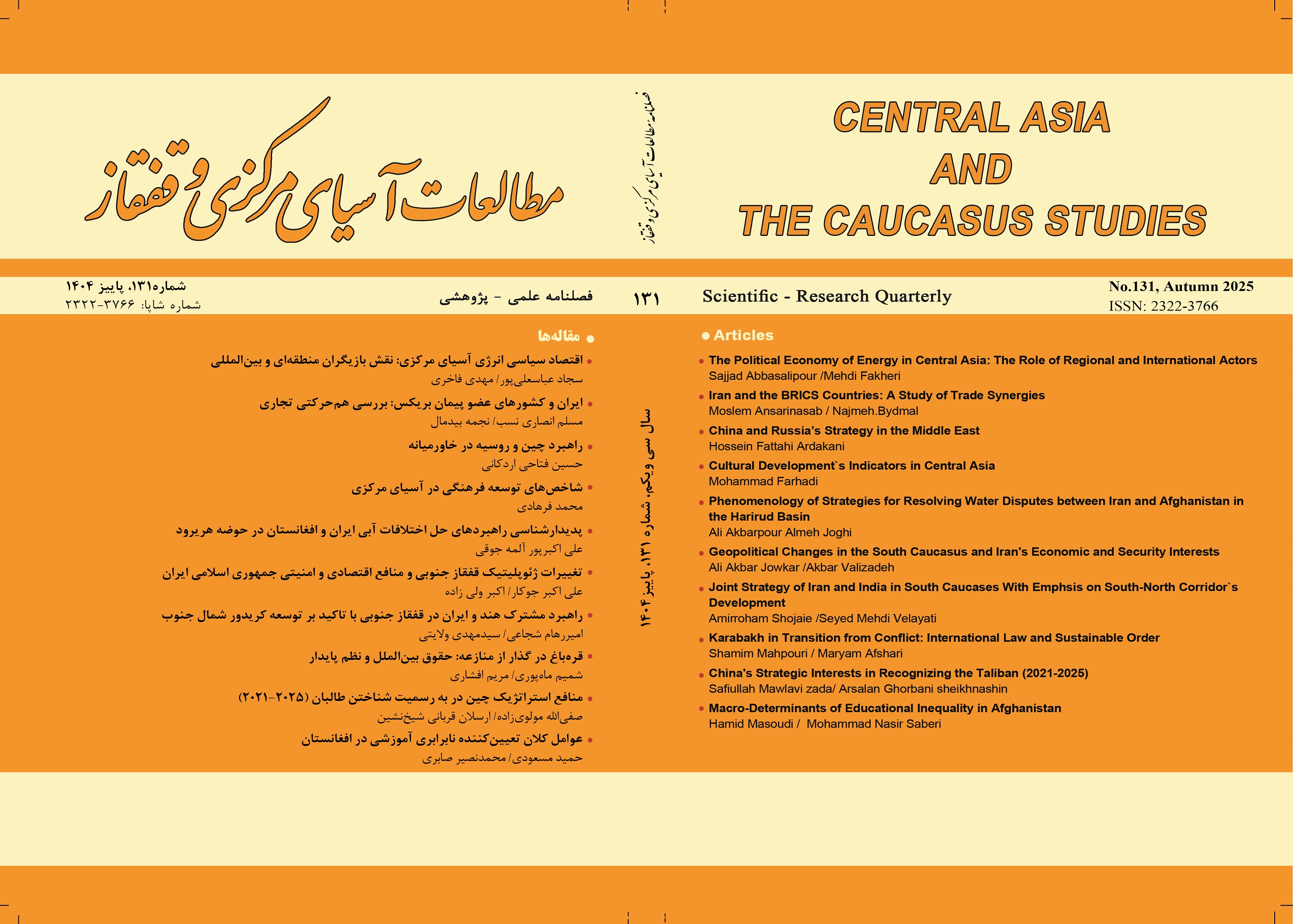
This study examines China’s approach toward the Taliban government in Afghanistan, aiming to analyze the challenges, opportunities, and strategic interests that shape Beijing’s stance on recognizing the Taliban. Drawing on Graham Allison’s Rational Actor Model, the Chinese state is conceptualized as a rational actor seeking to maximize its national interests in a complex and high-risk environment. The findings indicate that despite security threats posed by extremist groups such as the East Turkestan Islamic Movement (ETIM), China is actively seeking to exploit the economic and geopolitical opportunities emerging in Afghanistan. In this context, Beijing has deliberately avoided granting official recognition to the Taliban and has instead adopted a de facto recognition strategy—a cautious and flexible approach. This strategy minimizes political and security risks while laying the groundwork for potential future diplomatic and economic engagement. Ultimately, the research addresses the core question: How do China’s strategic interests influence its approach to recognizing the Taliban? China’s strategic calculations—centered on border security, countering extremism, accessing natural resources, and advancing the Belt and Road Initiative—have directly shaped its decision to adopt de facto recognition of the Taliban regime. This explains how Beijing’s strategic interests have influenced its policy choices toward the Taliban and resulted in both opportunities and challenges within the realm of Chinese foreign policy and regional security.
mawlavi zada,S . (2025). China's Strategic Interests in Recognizing the Taliban (2021-2025). Central Asia and The Caucasus Journal, 31(131), 227-252. doi: 10.22034/ca.2025.731857
MLA
mawlavi zada,S . "China's Strategic Interests in Recognizing the Taliban (2021-2025)", Central Asia and The Caucasus Journal, 31, 131, 2025, 227-252. doi: 10.22034/ca.2025.731857
HARVARD
mawlavi zada S. (2025). 'China's Strategic Interests in Recognizing the Taliban (2021-2025)', Central Asia and The Caucasus Journal, 31(131), pp. 227-252. doi: 10.22034/ca.2025.731857
CHICAGO
S mawlavi zada, "China's Strategic Interests in Recognizing the Taliban (2021-2025)," Central Asia and The Caucasus Journal, 31 131 (2025): 227-252, doi: 10.22034/ca.2025.731857
VANCOUVER
mawlavi zada S. China's Strategic Interests in Recognizing the Taliban (2021-2025). Central Asia and The Caucasus Journal. 2025;31(131):227-252 (In Persian). doi: 10.22034/ca.2025.731857