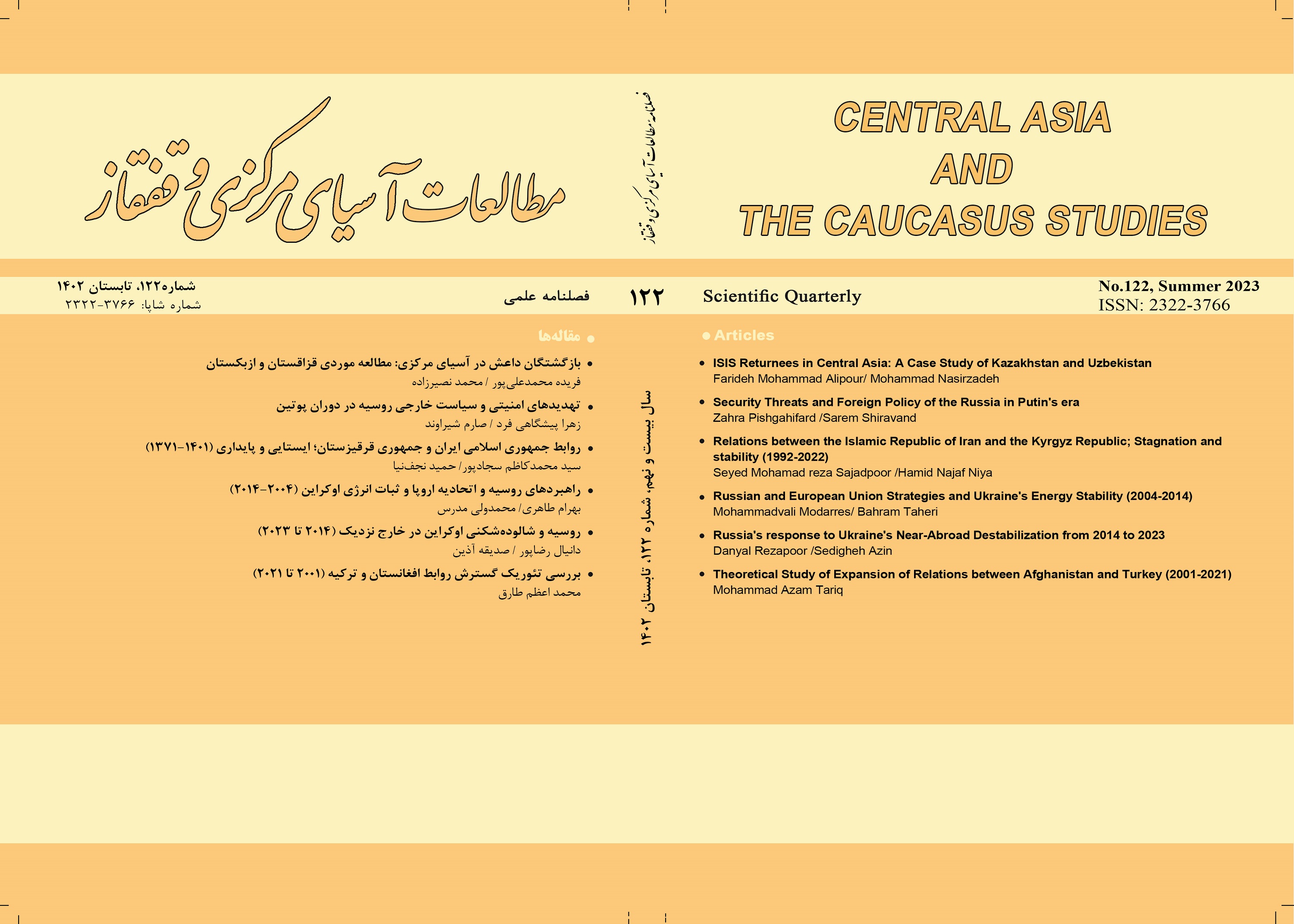
Volume & Issue: Volume 29, Issue 122, Summer 2023, Pages 3-161 
Number of Articles: 7
•	ISIS Returnees in Central Asia: A Case Study of Kazakhstan and Uzbekistan

• ISIS Returnees in Central Asia: A Case Study of Kazakhstan and Uzbekistan

Pages 3-34

https://doi.org/CA-2304-1677(R1)

Abstract Following the arrest of women and children by the Syrian Democratic Forces who had joined the ISIS terrorist group, the return of these people to their countries of origin was deemed an important issue in the fight against terrorism. While most European countries refused to accept them, Kazakhstan and Uzbekistan began to repatriate them. The current study seeks to address the question “How has the rehabilitation of ISIS women and children in Kazakhstan and Uzbekistan affected these people`s identities?” The hypothesis has been studied utilizing the Actor-network theory. This hypothesis has been tested: it has made it feasible to reinvent the identity of these individuals by placing women and children back from ISIS in a network of new social links. According to the findings of the study, the rehabilitation of these people in a network of social relations, as well as the use of the capacities of rehabilitation centers, schools, family, and neighborhood as translation mediators, has caused these individuals to reflect on their identity, rethink their social identity, and, as a result, successfully integrate in the society. Research results show that the rehabilitation of these people in the network of social relationships and the use of the capacity of rehabilitation centers, schools, families and neighborhoods as translation intermediaries has made women ISIS female and child returnees reflect on their identities and identities. Thereby rethinking their social identity and in a process of successful integration. In these countries, homeland adaptation and recovery activities as well as basic measures have been implemented individually with special emphasis on spiritual, psychological, ideological and family support, with government support in cases such as restoration of civil status, periodic financial support, and fight against social exclusion and the psychological distress that accompanies training for new professions such as translation, accounting and tailoring.

Security Threats and Foreign Policy of the Russia in Putins Era

Security Threats and Foreign Policy of the Russia in Putin's Era

Pages 35-64

https://doi.org/CA-2307-1692

Abstract The Russian Federation in the post-Soviet era has faced with many security threats. This article has studied the approaches of the Russian Federation under Vladimir Putin seeks to answer the fundamental question, " Why has Russia put realistic pragmatism and foreign policy codes on its foreign policy agenda under Putin?" The paper's hypothesis is that "the geopolitical threats and consequently the fragility of the Russian Federation's national security in the post-Cold War space have been the most important driver of pragmatism in its foreign policy". security threats at both domestic and foreign levels seem to undermine Russian security at three levels: domestic, regional and systemic. This has prompted Putin whit comprehensive approach to concept of security, to turn to Realistic pragmatism foreign policy to counter these threats. Research findings show that behavioral codes such as selective engagement, Emphasis on the formation of a multipolar system in the international system and the strengthening of regionalization, the strategy of reviving its power as a global power, economization of foreign policy, Russian-oriented institutionalism in Eurasia, The policy of looking to the East and cooperating with independent governments from the West and counter-terrorism which all have been designed and implemented to safeguard Russia's interests and security and reduce the potential impact of these threats on Russian national security. In this paper, the research method is in the form of formative and analytical explanations and attempts to find the root of the relationship between the dependent and independent variables of the article.

Relations between the Islamic Republic of Iran and the Kyrgyz Republic; Stagnation and Stability (1992-2022)

Relations between the Islamic Republic of Iran and the Kyrgyz Republic; Stagnation and Stability (1992-2022)

Pages 65-86

https://doi.org/CA-2206-1593

Abstract The Agreement on the Establishment of Formal Diplomatic Relations between the Islamic Republic of Iran and the Kyrgyz Republic was signed in 1992 as one of the five countries in the Central Asian region. The assessment of the relations between Iran and Kyrgyzstan during these thirty years, despite the opportunity to strengthen convergence in various dimensions, shows a kind of stagnation and stability. This study examines the achievements and failures of the Islamic Republic of Iran's relations with Kyrgyzstan and answers the question of how the causes of stagnation and stability of Iran-Kyrgyzstan relations after thirty years can be assessed. In response, it is hypothesized that the relations between Iran and Kyrgyzstan, despite many similarities, especially in the cultural and political fields; Always with a kind of stability, stagnation and lack of dynamism in various dimensions for reasons such as lack of priority and differences of ideas and lack of a coherent strategy to strengthen relations at the bilateral level, Kyrgyzstan's cautious foreign policy towards interaction with Iran and the presence of rival regional and international powers. Has been faced. However, in order to achieve the development of relations between the two countries in various dimensions, the expansion of cooperation in the economic dimension, along with cultural and political priorities in relations with Kyrgyzstan in competition with other actors, can be put on a serious agenda. The article is descriptive-analytical and inferential methodology has been used to achieve the objectives of the research.

Russian and European Union strategies and Ukraines Energy Stability (2004-2014)

Russian and European Union strategies and Ukraine's Energy Stability (2004-2014)

Pages 87-116

https://doi.org/CA-2310-1714

Abstract Ukraine has played an important role in the geopolitics of energy due to its geographical location and having a numerous gas pipelines. Although the interdependence between Russia, the European Union and Ukraine in the field of energy has provided a possibility for the expansion of cooperation, the formation of an asymmetric interdependence has affected Ukraine's energy stability. Based on this, this article seeks to answer the question that “How the strategies of Russia and the European Union have affected Ukraine's energy stability? In response to this question, it should be said that Russia by pursuing its energy strategies in ways such as diversifying transmission routes, dominating the energy markets, increasing prices, reducing and even cutting off the flow of energy transmission, imposing long-term contracts and using energy tools in political competitions in Ukraine, and the European Union in ways such as diversifying energy suppliers and focusing on renewable energy have influenced energy stability in Ukraine. In this study, qualitative method was used and data were collected based on library sources.

Russias response to Ukraines Near-Abroad Destabilization from 2014 to 2023

Russia's response to Ukraine's Near-Abroad Destabilization from 2014 to 2023

Pages 117-138

https://doi.org/CA-2307-1687(R2)

Abstract The separation of Crimea from Ukraine and its annexation to the territory of the Russian Federation in 2014 and the special military operations of the Russians against this country since February 2022 as linguistic symptoms suggest that Russia is seeking to expand its sphere of influence in the foreign region as much as possible؛ It is close and at the same time preventing the presence of the West in NATO in order to increase its security factor in it. Therefore, due to the fundamental difference in linguistic symptoms, the confrontation between Russia and Ukraine has not only not decreased, but has also developed strongly in the West's support for Ukraine's policies. On the other hand, considering that the issue of discretion or the will of Russian policymakers in the post-historical world is still based on two elements of historical (geopolitical) and ideological mentality in the region, it has eliminated the possibility of a quick regional solution against Russia's interests. Having said that, the question of the article is expressed in this way that according to the will of the power to develop the foundation with different forms of linguistic text; What has been the consequence of deconstruction against the interests of Russia by Ukraine in the near abroad? With the help of linguistic propositions, the answer to this conflict is proposed in such a way that Ukraine's attempt to separate from the centralist regional security complex led by Russia has the same consequences as the separation of the Crimean Peninsula from Ukraine and the declaration of independence of the Russian-inhabited regions and the tearing of this country into pieces in 2023 had. The method of writing the article is explanatory-analytical and the necessary information has been collected using library sources.

Theoretical Study of Expansion of relations between Afghanistan and Turkey (2001-2021)

Theoretical Study of Expansion of relations between Afghanistan and Turkey (2001-2021)

Pages 139-162

https://doi.org/CA-2303-1664(R1)

Abstract The international behaviors of governments are considered meaningful and identity oriented when their factors and motivations are identified, explained and scientifically interpreted in the framework of one of the theories of international relations. The deepening and expansion of relations between Afghanistan and Turkey is one of those behaviors that have taken place in the field of international relations, and the analysis and recognition of its causes and factors within the framework of the constructivist theory is the main goal of this article. The constructivist approach, while paying attention to semantic phenomena such as identity, history, narrating and mental perception, also pays attention to material structures such as political and economic interests. The main question of the article is what are the structural foundations that deepened and expanded the relations between Ankara and Kabul from 2001 to 2021.The hypothesis of the article is that the common social, cultural, historical, economic and political structures are considered to be the most important foundations and structural platforms that have facilitated the deepening and expansion of relations between Afghanistan and Turkey in the mentioned time period. Research findings show that "identity" and "interest" are the main axes of relations between Ankara and Kabul. with the difference that identity has played a role as a temporary structure and benefit as a permanent structure. It seems that Turkey has succeeded in achieving its desired goals and interests in relation to Afghanistan.