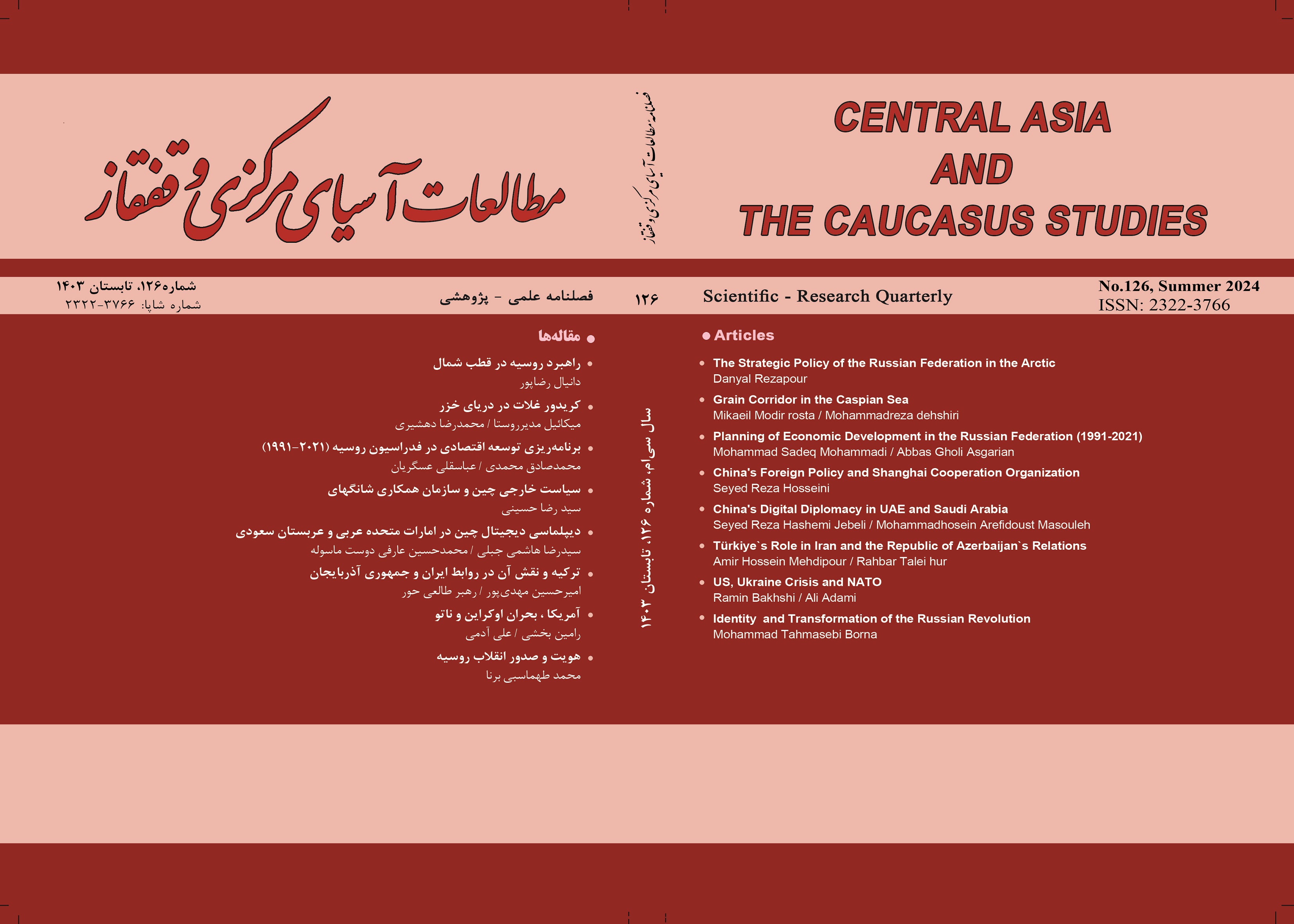
Volume & Issue: Volume 30, Issue 126, Summer 2024, Pages 3-218 
Number of Articles: 8
The strategic policy of the Russian Federation in the Arctic;

The strategic policy of the Russian Federation in the Arctic;

Pages 3-28

danyal rezapour

Abstract As one of the important global actors, Russia has experienced offensive and defensive roles in its lifetime due to the developments in the regional environment such as the Arctic and its power. The importance of the North Pole in this century became apparent when Russia sent a submarine to a depth of 4261 meters in the Arctic Ocean on August 2, 2007, and installed the country's flag on the bottom of this ocean. Russia, in addition to having the best border with the Pole the largest amount of resources estimated in this region, and the largest ice fleet in the world due to the unique geographical location of the North Pole compared to it, in terms of aristocracy in different regions of this country for Any possible military attack has a strategic position. The main research question concerns the principles and strategic nature of Russia's policies in the Arctic region. In response to this question in a descriptive-analytical way and according to the principle of explaining strategies based on interests in the framework of power, Russia's strategies in this region are based on the conditions and the origin and source of the threat. and include a set of strategies, including strategies derived from domestic policy for the exploitation of economic and environmental benefits, foreign policy including the strategy of tension and strong reaction in the face of threats caused by the hegemon (NATO expansion) and its allies. It is a coalition strategy with extra-regional actors (China). As one of the important global actors, Russia has experienced offensive and defensive roles in its lifetime due to the developments in the regional environment such as the Arctic and its power. The importance of the North Pole in this century became apparent when Russia sent a submarine to a depth of 4261 meters in the Arctic Ocean on August 2, 2007, and installed the country's flag on the bottom of this ocean. Russia, in addition to having the best border with the Pole the largest amount of resources estimated in this region, and the largest ice fleet in the world due to the unique geographical location of the North Pole compared to it, in terms of aristocracy in different regions of this country for Any possible military attack has a strategic position. The main research question concerns the principles and strategic nature of Russia's policies in the Arctic region. In response to this question in a descriptive-analytical way and according to the principle of explaining strategies based on interests in the framework of power, Russia's strategies in this region are based on the conditions and the origin and source of the threat. and include a set of strategies, including strategies derived from domestic policy for the exploitation of economic and environmental benefits, foreign policy including the strategy of tension and strong reaction in the face of threats caused by the hegemon (NATO expansion) and its allies. It is a coalition strategy with extra-regional actors (China).

Grain Corridor in the Caspian Sea

Grain Corridor in the Caspian Sea

Pages 29-54

Mikaeel Modirrousta, Mohammadreza Dehshiri

Abstract Iran neighbors four other coastal countries in the Caspian Sea, among which two countries, Russia and Kazakhstan, are among the largest grain and wheat exporters in the world. Iran also has technology and skills in grain processing and food production, which is always semi-active. The main question is, what is the benefit of the grain corridor in the Caspian Sea for Iran, and how can Tehran provide the basis for its establishment and development?
In this research, two theories of "comparative advantage" and "local comparative advantage" are used, based on which Iran has opportunities like advanced technology for grain processing, legal frameworks such as the Eurasian Economic Union agreement, and an accessible and shorter geographical route like INSTC.
Based on the findings of the research, some mistakes regarding the issue of food security and preventing the import of grains have made Iran unable to become an exporter of processed grains in the world. To answer this challenge, the model of Turkey as one of the largest grain exporters in the world has been compared. The results show that Iran can produce the grain it needs internally and process and import more than its domestic production from Russia and Kazakhstan, then by adding value, export it to other countries.
This is the method that Turkey uses and benefits from its income every year. As a result, according to these factors and Iran's potential to transfer these goods, the Caspian Sea can become an international corridor in the field of grains, creating a type of value chain between the three coastal countries.

Planning and Economic Development in the Russian Federation (1991-2021)

Planning and Economic Development in the Russian Federation (1991-2021)

Pages 55-90

Mohammad Sadeq Mohammadi, Abbas Gholi Asgarian

Abstract Development as a comprehensive process aimed at concerned with improving all facets of a nation's well-being is closely connected with a political economy approach seeking to bring into realization the “Successful State – Successful Economy” dichotomy. Different states adopted different models of economic growth and development based on numerous considerations such as one’s spatial planning. Russia, due to its territorial extent and underdevelopment, after the imperial colonial periods and the centralized planned economy of the USSR, is currently undergoing its third phase of economic transition. This paper seeks to provide an answer to “How has the authoritarian centralist planning affected the economic development in Russia?” The hypothesis argues that authoritarian development in Russia does not include fundamental changes in the economic structures of Russia, but it relies on the rent of the country's natural resources. This approach along with individual authoritarianism, due to the rapid establishment of non-simulative extractive industries in limited areas and also the lack of market logic, has so far marked the unbalanced and unstable development in Russia. This basic descriptive research is of a qualitative type. Furthermore, the data collection method is that of library research conducted alongside interviews. As well as the model of data analysis is the theory of growth poles.

Chinas Foreign Policy and  the Shanghai Cooperation Organization

China's Foreign Policy and the Shanghai Cooperation Organization

Pages 91-118

Seyed Reza Hosseini

Abstract The Shanghai Cooperation Organization (SCO) was established in 2001 with the priority of security and political cooperation. China, as the main founder of the organization, follows various goals, including regional development and security, pursuing the goals of the Belt and Road Initiative, and laying the groundwork for the new world order by confronting unilateralism. This article, based on the theory of institutional balancing, considers the Shanghai Organization as an appropriate tool for achieving China's goals and, in addition to these goals, investigates the impact of recent international changes, including the situation in Afghanistan, the war in Ukraine, and the escalation of China's confrontation with the United States, on the position of the Shanghai Cooperation Organization in the foreign policy of China and concludes that the mentioned factors have strengthened the position of the organization in the eyes of Chinese policymakers. To realize its goals and interests through the organization, China is facing challenges such as the lack of internal disunity within the Organization and fundamental conflicts with the other member states, the resolution of which requires thorough planning and adopting a suitable approach. The Descriptive Analysis method and library and internet data have been used in writing the article.

Chinas Digital Diplomacy in UAE and Saudi Arabia

China's Digital Diplomacy in UAE and Saudi Arabia

Pages 121-146

Seyed Reza Hashemi Jebeli, Mohammadhosein Arefidoust Masouleh

Abstract China's growing need for global energy resources has made this country pay special attention to the Arab countries of the Persian Gulf and the world's largest energy producers. In this regard, the representation of a positive image of Beijing in the eyes of rulers and Arab societies is one of the requirements for the expansion of political, economic, and social relations. This issue can strengthen Beijing's influence and position in the Middle East. On the other hand, Arab politicians, to maintain their legitimacy and present a positive image of Arab countries as developing advanced, and prosperous nations, need to attract large investments from powerful countries such as China in the field of digital infrastructures and social media platforms. This research aims to answer the question of what effect China's digital diplomacy towards Saudi Arabia and the United Arab Emirates has had on the development process of this country's relations with Saudi Arabia and the UAE and whether this diplomacy has improved the relations between these two countries with China or not. The results of this study suggest that with the beginning of China's focus on the need to enter the Middle East to take advantage of investment opportunities and huge resources, and China's understanding of this to present a positive and peaceful image of itself by using digital diplomacy to expand its influence in this region, China's relations with the mentioned countries have expanded significantly. These relations have been progressing despite the stonewalling of the West and the United States. This is largely due to China's digital diplomacy. The present paper is a descriptive analysis using the documentary and library resources. .

Türkiye`s Role in Iran and the Republic of Azerbaijan`s Relations

Türkiye`s Role in Iran and the Republic of Azerbaijan`s Relations

Pages 145-166

Rahbar Talei hur, Amir Hossein Mehdipour

Abstract In the Caucasus disputes, some regional powers such as Turkey seek to play a role in the equations of this region. In line with the balance of power with Iran in the Caucasus region, Turkey is trying to seriously pursue its presence in support of Baku, which can impact the relations between the Islamic Republic of Iran and the Republic of Azerbaijan. Therefore, the main goal of this article is to investigate the role of Turkey in the security of the relations between the Islamic Republic of Iran and the Republic of Azerbaijan, and the research question can be expressed as what role Turkey played in the security of the relations between Iran and Azerbaijan? In response to the research question, using the theoretical framework of the Copenhagen school, a hypothesis is proposed as follows: Turkey, by using pan-Turkic policies, military cooperation, arms support, and intelligence support from the Republic of Azerbaijan and facilitating the presence of Takfiri forces in the region, the security of relations between Iran and Azerbaijan has played a role. The research findings show that Turkey's most important goal in the Caucasus is long-term political, economic, and security presence and influence, which it pursues with the cooperation of Azerbaijan. In addition to the linguistic, ethnic, and cultural links between the Republic of Azerbaijan and Türkiye, a combination of various political, defense, and economic factors has also been affected.

US, Ukraine Crisis, and NATO

US, Ukraine Crisis, and NATO

Pages 167-192

ramin bakhshi, ali adami

Abstract The Russian Military intervention in Ukraine was one of the most serious international crises in international relations since the end of the Cold War because it included the threat of a large-scale conflict in Europe, between Russia on the one hand, and the United States of America, the European Union and NATO on the Other hand. The study specifically examines the dimensions, determinants, characteristics, and features of US policy towards the Russian military intervention in Ukraine, and its repercussions on NATO, In its axes, the study focused on the dimensions and developments of the Ukrainian crisis, the strategic importance of Ukraine in the Russian and American perspectives, the determinants of US policy towards the Russian-Ukrainian war, the repercussions of the Ukrainian crisis on NATO, and the expected scenarios for the end of the Russian-Ukrainian war. This article reached several important results using a descriptive-analytical approach; Among other things, the American policy towards Russia's attack on Ukraine is multifaceted and includes diplomatic efforts, preventing further aggression, economic sanctions, military aid to Ukraine, and strengthening NATO's deterrence and defense capabilities in the region. Also, the Russia-Ukraine war restored the coherence of the North Atlantic Treaty in an unprecedented way and made it more coherent than before. This pushed European countries towards more armaments and significantly increased European military spending, prompting neutral countries such as Finland and Sweden to formally apply to join NATO, signifying developments that it is not in the interests of Russia.

Identity  and Transformation of the Russian Revolution

Identity and Transformation of the Russian Revolution

Pages 193-222

mohammad tahmasebi borna

Abstract The inherent revolutionary optimism, along with the idealistic enthusiasm resulting from the creation of new revolutionary structures, brings global dreams and perspectives to the revolutionaries and is introduced in all the actions and thoughts of the revolutionary leaders as the main goal of every revolution. On the other hand, there are necessities and limitations besides the mission defined in the process of issuing the revolution, which play a very important role in building a new revolutionary identity. Examining elements such as geography and geopolitical limitations, international pressures, public interests, structural necessities, ethnic and national issues, and their role, and examining the dimensions of this influence and effectiveness is one of the goals of this research. The author tries to use the theory of constructivism to address the most important influencing factors in the Russian revolution, focusing on the export of the revolution, and to explain how the identity components influence and play a role in the export strategy of the Russian October Revolution. In this research, we want to investigate the process and why of this rotation in an interactive process between the revolutionary structure and the revolutionaries and the external components of the identity sector. It seems that the Russian Revolution has been watching it slowly conquering its ideals and its heart with internal and external realities, and its only action has been a reluctant alignment of this interaction in favor of hard external components.