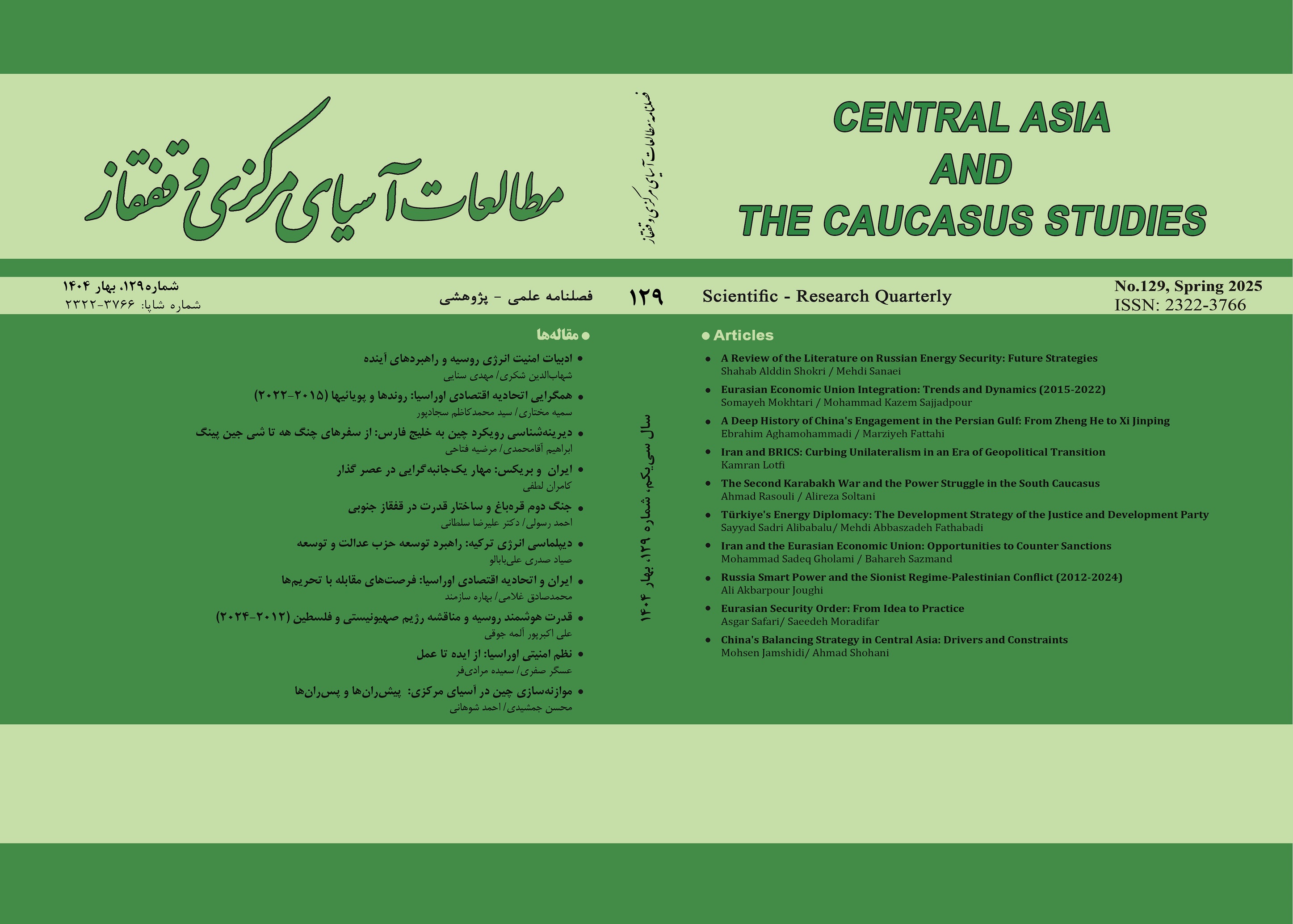
Volume & Issue: Volume 31, Issue 129, Spring 2025, Pages 3-282 
Number of Articles: 10
The Literature of the Russian Energy Security: Future Strategies

The Literature of the Russian Energy Security: Future Strategies

Pages 3-34

Shahab Alddin Shokri, Mehdi Sanaei

Abstract The Literature of the Russian Energy Security: Future Strategies This study surveys the academic literature on Russian energy security, focusing on developments following the onset of the war in Ukraine. Considering the extensive Western sanctions targeting Russia's energy sector, this study explores the key strategic components shaping Russia's contemporary energy security posture. Employing a systematic literature review methodology, 90 pertinent articles and scientific documents published between 2010 and 2024 were selected and analyzed. The analysis focused on three core areas: concepts of energy security, Russian foreign policy, and economic sanctions. Qualitative thematic analysis of the selected literature was conducted using MAXQDA software. To complement the qualitative synthesis and support the interpretation of trends within the literature, descriptive quantitative analyses (such as frequency counts or trend analysis) were performed using SPSS and OriginPro software. The findings indicate that Russia's "Eastern pivot"—a strategic reorientation of energy policy and exports towards Asia—has gained prominence as a central element of the country's energy security strategy in the wake of the war in Ukraine and subsequent sanctions.

Eurasian Economic Union Integration: Trends and Dynamics 
(2015-2022)

Eurasian Economic Union Integration: Trends and Dynamics (2015-2022)

Pages 35-66

Somayeh Mokhtari, Mohammad Kazem Sajjadpour

Abstract Following the dissolution of the Soviet Union in 1991, Russia pursued various strategies to maintain influence within its near abroad. Several post-Soviet institutions emerged against a backdrop of evolving relations with the West and the rise of integrationist concepts like Neo-Eurasianism, which emphasizes regional cooperation and a distinct identity. The Eurasian Economic Union (EAEU), established in 2015 by Russia, Kazakhstan, Belarus, Armenia, and Kyrgyzstan, is a key initiative designed to foster deep economic integration, partially inspired by the European Union model. This article investigates the integration trajectory of the EAEU between 2015 and 2022, addressing the question: What were the primary trends and dynamics shaping the EAEU's integration path during this period? Employing the analytical frameworks of Neo-Functionalism and Neoliberal Institutionalism, the research finds that the EAEU achieved notable success in building institutions, developing common regulations, and establishing standards, aligning with Neo-Functionalist expectations of progress in formal structures. However, progress in practical economic integration—a core focus analyzed through the lens of Neoliberal Institutionalism's emphasis on achieving cooperative gains—lagged significantly. Specifically, the establishment of a fully operational common market, the consistent application of common external customs tariffs, and the implementation of coordinated economic policies experienced considerable delays during the period studied.

A Deep History of Chinas Engagement in the Persian Gulf: From Zheng He to Xi Jinping

A Deep History of China's Engagement in the Persian Gulf: From Zheng He to Xi Jinping

Pages 67-94

Ebrahim Aghamohammadi, Marziyeh Fattahi

Abstract Relations between China and Iran have varied significantly throughout history. This study concentrates on two distinct historical periods—the early 15th century (Ming Dynasty) and the early 21st century (Xi Jinping era)—to investigate the primary drivers that compelled these two influential Chinese governments to focus strategically on the Persian Gulf and the Strait of Hormuz. Employing a descriptive-analytical methodology that draws upon historical and contemporary sources, the study tests the hypothesis that the Persian Gulf and Strait of Hormuz constitute a pivotal region for the success of global power strategies. The findings suggest that the Ming Dynasty, particularly during the voyages of Zheng He, sought to enhance its influence over international trade routes by leveraging the region's commercial and strategic significance. Correspondingly, the contemporary administration under Xi Jinping, in pursuing its global initiatives, recognizes the enduring geopolitical and economic importance of this region, especially for energy security and access to Persian Gulf oil.

Iran and BRICS: 
Curbing Unilateralism in an Era of Geopolitical Transition

Iran and BRICS: Curbing Unilateralism in an Era of Geopolitical Transition

Pages 95-124

kamran lotfi

Abstract  
Seeking to counterbalance international unilateralism, Iran employs a strategy that combines domestic strengths with strategic partnerships, viewing institutions like BRICS as vital platforms. Motivated by a revisionist perspective on the global order, Iran actively cultivates relationships with emerging powers while opposing cooperation with established hegemonic forces. Key objectives, pursued through BRICS membership, include strengthening Iran's geopolitical position and working to delegitimize and contain perceived unilateralist hegemony.

The Second Karabakh War and the Power Struggle
 in the South Caucasus

The Second Karabakh War and the Power Struggle in the South Caucasus

Pages 125-152

ahmad rasouli

Abstract The Second Nagorno-Karabakh War marked a pivotal juncture, initiating a significant reconfiguration of the security order in the South Caucasus and redefining the roles of regional and extra-regional actors. Within this evolving landscape, the strategic latitude of regional players is increasingly influenced by shifting power dynamics and the competing interests of dominant states. Observable changes in traditional alignments—such as the apparent decline of Russia's influence over Armenia and the expanding strategic footprints of Turkey and Israel—underscore these transformations and heighten the potential for renewed conflict. Critical variables are now shaping the emerging order, including Armenia's foreign policy reorientation, the uncertain trajectory of Armenia-Azerbaijan peace negotiations, Georgia's geopolitical positioning, and the intensified contest over strategic corridors. These developments reflect the underlying dynamics of great power competition intersecting with local rivalries. The resulting complexity, characterized by a multitude of actors and intricate interdependencies, renders outcomes increasingly unpredictable and potentially challenges conventional analytical frameworks for understanding regional security transformations

Türkiyes Energy Diplomacy: The Development Strategy of the Justice and Development Party

Türkiye's Energy Diplomacy: The Development Strategy of the Justice and Development Party

Pages 153-176

Sayyad Sadri Alibabalu, Mehdi Abbaszadeh Fathabadi

Abstract Energy diplomacy constitutes a critical strategy for industrialized consumer nations, emerging energy producers, and transit states alike. Amidst recurring geopolitical tensions between Russia and the West—notably underscored by conflicts related to Ukraine since 2006—Türkiye’s strategic importance as a potential energy corridor to Europe has been significantly heightened. This study analyzes the energy diplomacy strategy of Türkiye under the Justice and Development Party (AKP). It assesses how Ankara has sought to capitalize on this strategic position, considering factors such as its growing domestic energy demand and its unique location astride East-West transit routes. The findings demonstrate that Türkiye’s targeted diplomatic initiatives have enhanced its negotiating leverage within global energy markets and asserted its role as a key regional energy actor, particularly concerning European energy security.

Iran and the Eurasian Economic Union: Opportunities to Counter Sanctions

Iran and the Eurasian Economic Union: Opportunities to Counter Sanctions

Pages 177-200

mohammadsadegh gholami, bahareh sazmand

Abstract US sanctions against Iran have severely hampered production, employment, business activity, and development projects, thereby decreasing economic efficiency and national income. Consequently, amid the growth of regional cooperation and the formation of economic blocs, Iran has increasingly viewed the Eurasian Economic Union (EAEU) as a vital platform for economic partnership. This research aims to identify the opportunities that membership in the EAEU could offer Iran for countering unilateral US sanctions. The central research question is: How can membership in the EAEU enable Iran to counter sanctions and mitigate their economic impact? Key identified opportunities include enhanced cooperation among sanctioned states, the application of preferential tariffs, the development of a stronger regional Asian focus, and expanded intra-regional trade. This is an applied study employing a mixed-methods design. Guided by the theoretical framework of modern regionalism, the research uses a descriptive-inferential approach and content analysis to test its central hypothesis.

Russia Smart Power and the Sionist Regim-Palestinian Conflict (2012-2024)

Russia Smart Power and the Sionist Regim-Palestinian Conflict (2012-2024)

Pages 201-228

Ali Akbarpour Almeh Joghi

Abstract Within the anarchic framework of the international system, governments adjust their foreign policy by their interests and environmental conditions. Russia has also adopted a policy based on smart power in the Middle East by combining hard and soft power. The country has used hard power to confront fundamentalist groups and, at the same time, has strengthened its position as a balanced actor on the issue of Palestine and Sionist regime by utilizing soft power. This research shows that Russia's main goal has been to maintain geopolitical interests, reduce costs, and increase regional influence. Moscow has also tried to establish its international image as a peace mediator. This dual policy has been a smart response to the geopolitical complexities of the Middle East.

Eurasian Security Order: From Idea to Practice

Eurasian Security Order: From Idea to Practice

Pages 229-258

Asgar Safari, Saeedeh Moradifar

Abstract The intensification of recent global trends—including the war in Ukraine, growing US-China competition, and heightened geopolitical rivalry—has fueled speculation about shifts in the international order, with a particular focus on Eurasia. In recent years, Russia and China have made concerted efforts to reshape the security architecture of Eurasia. This study addresses the central question: What are the nature and characteristics of the regional security order that Russia and China envision for the region? The study argues that Russia and China seek to establish a regional security order based on integration. This envisioned order is explicitly anti-hegemonic and founded on principles such as the distribution of power and responsibility, equality, respect for sovereignty, and, critically, the indivisibility of security. This research employs a qualitative, descriptive-analytical methodology, evaluating the hypothesis through the analysis of official documents, policy statements, and scholarly literature.

The Drivers and Sons of Chinas Balancing in Central Asia in the New Millennium

The Drivers and Sons of China's Balancing in Central Asia in the New Millennium

Pages 259-282

mohsen jamshidi, ahmad shohani

Abstract One of the most central issues that has attracted the attention of all analysts of the international system from the perspective of strategic studies is how China plans and plays a role in the strategic regions of the international system to advance its international interests using the resources and considerations it has. The question is, what parameters will affect China's foreign policy strategy towards the countries of the Central Asian region? It seems that China, by taking advantage of the opportunities that have arisen in the Central Asian region and by increasing its influence and economic, security-political cooperation in line with the construction of a multipolar hegemonic system in the international system, has moved (inclined) towards regional and regional balancing. The above research is of an applied type and has been analyzed and compiled with a qualitative method and a descriptive-analytical approach and in a library manner. The purpose of this research is to identify China's capacities and capabilities in the Central Asian region. The findings of the present study show that, in the new millennium, China, taking advantage of its special international position (status and position), and in order to advance its goals and interests, should take advantage of the opportunities that have emerged and try to move in the Central Asian region by creating regional balance and adopting a new regionalism strategy. ,