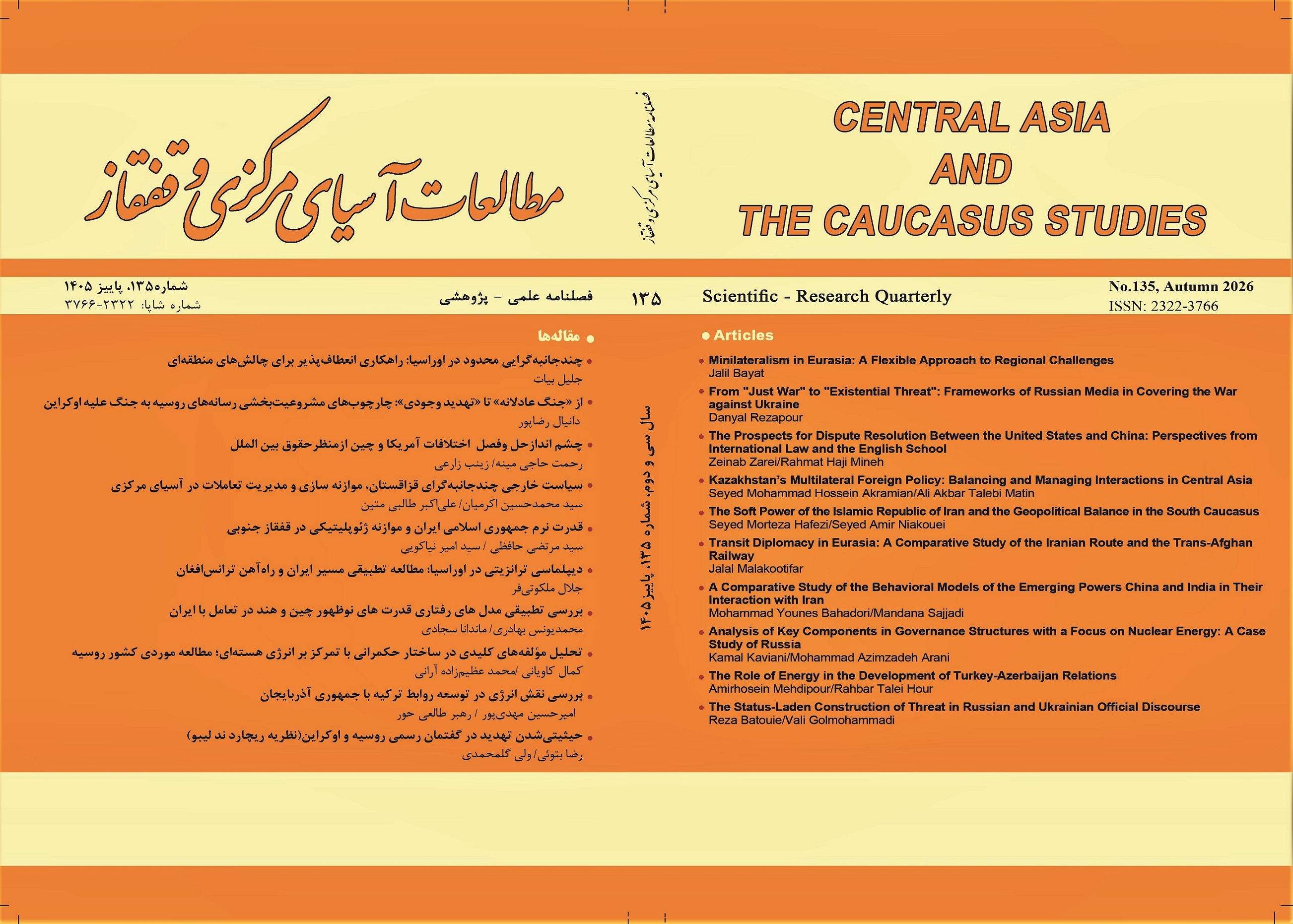
Volume & Issue: Volume 32, Issue 135, Autumn 2026, Pages 0-282 
Number of Articles: 14
Minilateralism in Eurasia: A Flexible Mechanism for Regional Challenges

Minilateralism in Eurasia: A Flexible Mechanism for Regional Challenges

Pages 3-24

https://doi.org/10.22034/ca.2026.2081591.1962

Jalil Bayat

Abstract In recent years, the inefficiency and sluggishness of traditional multilateral institutions in Eurasia have prompted states to seek alternative, more flexible arrangements. This study analyzes agreements based on minilateralism in Eurasia and focuses on why states, alongside multilateral institutions such as the Shanghai Cooperation Organization and the Eurasian Economic Union, turn to smaller, more flexible pacts. The main research question asks why these agreements form, and the hypothesis states that they emerge primarily as complementary mechanisms to multilateral institutions, in response to the limitations and sluggishness of traditional institutions, as states seek a faster, more targeted, and less costly mechanism to address regional threats and opportunities. Adopting a descriptive-analytical approach through document review and case studies, the research examines the structural, security-geopolitical, and economic factors shaping these agreements and their differences from traditional multilateral institutions. The findings indicate that these agreements operate primarily as complementary mechanisms alongside traditional multilateral institutions and, under conditions of institutional gridlock, provide capacity for more effective and flexible coordination among member states. Finally, the article highlights the importance of these arrangements in redefining patterns of regional cooperation and in understanding future power dynamics in Eurasia.

From Just War to Existential Threat: An Analysis of the Legitimization Frameworks of Russian Media in Covering Special Military Operations Against Ukraine

From "Just War" to "Existential Threat": An Analysis of the Legitimization Frameworks of Russian Media in Covering Special Military Operations Against Ukraine

Pages 25-50

https://doi.org/10.22034/ca.2026.2081769.1965

danyal rezapour

Abstract Russia’s current policy towards Ukraine can be seen as a prominent example of regionalism and re-territorialization, based on geopolitical considerations and the redefinition of regional identities. Within this framework, the Kremlin, using a set of “signifiers” and discursive tools, especially the media, attempts to produce, represent, and solidify its preferred narrative of the conflict. The main goal of this article is to analyze the role of the Russian media in creating and disseminating the Kremlin’s official narratives as a means of legitimizing the war against Ukraine and influencing public opinion in both Russian and Ukrainian societies. By depicting the Russia-Ukraine conflict as a narrative story, the present study explains the crisis through the narrative beliefs and semantic frameworks of political leaders and elites. The media war between the two sides has been an arena of intense linguistic and discursive interactions in which language, terms, and concepts are strategically used to shape public perceptions and normalize violence. The central question of the article is how legitimizing strategies have been used in the discourse of the Russian media in 2022 to justify the “special military operation” against Ukraine, and how they relate to each other. The research hypothesis is based on the assumption that the Russian media have legitimized the discourse of the war by simultaneously employing the strategies of moral evaluation/altruism, authority and expert voice, hypothetical future, mythologizing, and rationalization; in such a way that the moral evaluation strategy,

Prospects for the Resolution of the US-China Disputes from the Perspective of International Law

Prospects for the Resolution of the US-China Disputes from the Perspective of International Law

Pages 51-78

https://doi.org/10.22034/ca.2026.2052853.1858

Rahmat Haji Mineh,, Zeinab zarei,

Abstract The growing differences between the United States of America and the People's Republic of China, as the two world superpowers, have taken on broad dimensions and encompassed various political, economic, security, and ideological arenas. These differences, which range from trade and technology disputes to human rights and regional security issues, have not only affected their bilateral relations but also challenged international stability and order. This article, by examining documents such as UN resolutions and bilateral declarations, as well as data such as economic indicators and trade statistics, and using content analysis, attempts to examine the prospects for resolving the US-China differences from the perspective of international law. The main question of the article is that given the deep and widespread differences between the US and China, is the current international legal framework capable of effectively managing and resolving these differences, or do we need new and innovative approaches in interpreting and implementing international law to adapt to the new geopolitical and economic realities of the world? The findings of the article show that international law, by providing legal frameworks and mechanisms, can play an important role in managing and reducing these tensions. Focusing on concepts such as sovereignty, non-intervention, peaceful resolution of disputes, and commitment to international treaties can provide solutions to reduce tensions and create a basis for cooperation.

Kazakhstans multilateral foreign policy, balancing and managing interactions in Central Asia

Kazakhstan's multilateral foreign policy, balancing and managing interactions in Central Asia

Pages 79-104

https://doi.org/10.22034/ca.2026.2089473.1991

seyed mohmamd hosein akramiyan, ali akbar talebi matin

Abstract Since its independence in 1990, Kazakhstan, as one of the leading countries in Central Asia, has considered following a balanced multilateral foreign policy model in international and regional interactions with Eastern powers (including China and Russia) and Western powers (including the European Union and the United States). Efforts to benefit from “multi-level and indivisible” mutual interests, pursuing “mutual procedures and principles,” as well as taking action and action at the “reciprocal” level in relations and interactions with regional and trans-regional actors are on the agenda of this country’s governance. The process of these interactions and relations can be examined in the framework of the “balanced multilateralism” model. In this paper, the levels of this relationship are examined case by case and in relation to four actors; China and Russia (in the form of Eastern actors) and the United States and the European Union (in the form of Western actors) will be explained and analyzed. The data collection method in this paper is the use of a library model and is based on a descriptive-analytical model in terms of methodology. The results of the research show that the pursuit of the "independent", "interactive", "pluralistic" and "intelligent" model of Kazakhstan's foreign policy towards Russia, China, as well as the United States and the European Union, has occurred and continued in the form of multilateral balancing.

The Soft Power of the Islamic Republic of Iran and Geopolitical Balancing in the South Caucasus

The Soft Power of the Islamic Republic of Iran and Geopolitical Balancing in the South Caucasus

Pages 105-138

https://doi.org/10.22034/ca.2026.2078247.1952

seyed morteza hafezi, seyed amir Niakoee

Abstract In recent years, soft power has emerged as one of the principal pillars of countries' foreign policies, particularly in strategically vital regions such as the South Caucasus. This article addresses the fundamental question of how the Islamic Republic of Iran can leverage its soft power capacities to counter the expansion of relations among Turkey, Israel, and the Republic of Azerbaijan in the South Caucasus—relations that, relying on security, economic, and transit linkages, have influenced the regional balance of power. The research methodology is based on content analysis of official documents, credible scholarly sources, and secondary data spanning the period from 2010 to 2024, employing the theoretical framework of Nye and Papp. The study's hypothesis posits that the targeted application of the Islamic Republic of Iran's soft power components—through enhancing regional legitimacy and persuasive power—can lead to a reduction in the geopolitical influence of the Turkey–Israel–Azerbaijan cooperation in the South Caucasus. Four key strategies are examined: preventing access to territory, wedging diplomacy, demonstrating national resolve for balancing, and delegitimizing the hegemon. The findings indicate that Iran, by capitalizing on shared cultural and historical ties, religious diplomacy, and active participation in regional institutions, can effectively resist these relations and consolidate and strengthen its position within the security architecture of the South Caucasus.

Transit Diplomacy in Eurasia: A Comparative Study of the Iranian Route and the Trans-Afghan Railway

Transit Diplomacy in Eurasia: A Comparative Study of the Iranian Route and the Trans-Afghan Railway

Pages 139-170

https://doi.org/10.22034/ca.2026.2109389.2022

Jalal Malakootifar

Abstract Landlocked Central Asian countries seek secure and cost-effective access to open waters following geopolitical shifts caused by the Ukraine crisis and the restructuring of supply chains. Using a qualitative and comparative-analytical method, this study evaluates two strategic options—the Iranian transit corridor (Chabahar and Bandar Abbas ports) and the Trans-Afghan Railway—based on four indicators: cost-time, infrastructure capacity, operational security, and political-financial sustainability. Findings indicate that Iran’s route holds short-term superiority due to existing infrastructure and operational stability; whereas the Trans-Afghan Railway, despite its shorter distance, faces security challenges in Afghanistan and financing deadlocks. These two routes serve as complementary tools for transit diversification within the theoretical frameworks of geoeconomics and complex interdependence. This study adopts a qualitative, comparative-analytical approach utilizing library resources, institutional reports (World Bank, UNESCAP, ADB), and empirical data regarding regional corridors. The study integrates Geoeconomics (Luttwak, 1990; Blackwill & Harris, 2016) and Complex Interdependence (Keohane & Nye, 2012) to explain how connectivity infrastructure acts as a tool of statecraft and how Central Asian states pursue multi-vector transit diversification to mitigate vulnerability.
Keywords: Central Asia, Geoeconomics, Transit, Chabahar Port, Trans-Afghan Railway, North-South Corridor.

A Comparative Analysis of the Behavioral Models of Emerging Powers: China and India in Their Engagement with Iran

A Comparative Analysis of the Behavioral Models of Emerging Powers: China and India in Their Engagement with Iran

Pages 171-192

https://doi.org/10.22034/ca.2026.2071434.1922

Mohammad younes bahadori, Mandana Sajjadi

Abstract Situated between the Caucasus and the Indian Ocean, the Islamic Republic of Iran holds a strategic position with the capacity to influence the Persian Gulf, the Caspian Sea, Afghanistan, and even Pakistan. This has granted Iran particular significance for emerging powers. Recognizing the dynamics of the international system, Iran has implicitly adopted a "Look to the East" strategy. Given the growing importance of China and India in global and regional developments, assessing their foreign policies toward Iran is essential to understanding prospects for future cooperation. The central question of this study is: What behavioral models have these emerging powers followed in their engagement with Iran since 2015? Using a hypothesis-testing approach based on the theoretical model of emerging powers’ behavior and conducting a comparative analysis of relevant documents, the findings reveal that both China and India have pursued pragmatic and cooperative approaches toward Iran. Their behavior is driven by factors such as economic interests, energy security, regional stability, and geopolitical considerations. Among the two, China has demonstrated a more consistent and assertive application of this behavioral model.

Analysis of Key Components in Governance Structures with a Focus on Nuclear Energy: A Case Study of Russia

Analysis of Key Components in Governance Structures with a Focus on Nuclear Energy: A Case Study of Russia

Pages 193-226

https://doi.org/10.22034/ca.2026.2080291.1969

, Kamal Kavyani, Mohammad Azimzadeh Arani

Abstract Energy governance is a set of formal and informal processes, institutions, and mechanisms that are designed and implemented with the aim of regulating the interactions of various actors in the energy supply chain. In the first part of this research, a theoretical framework has been developed through documentary and library methods. Another part of this article examines the Russian nuclear energy governance system through the “case study” method.
The findings of the article show that Russia has been able to create an appropriate separation of duties and authorities in the nuclear energy sector at three levels of policy-making, regulation, and service provision. The policy-making level is mainly in the hands of upstream government and legislative institutions such as the Federal Presidency, the State Duma, the Ministry of Energy and the Ministry of Foreign Affairs. The regulation level is also in the hands of independent regulatory bodies and specialized organizations such as the Federal Service for Ecological, Technological and Nuclear Supervision, the Ministry of Environment, the Non-Profit Market Council, and the Federal Antimonopoly Service, which are responsible for tasks such as ensuring safety, standardization, issuing licenses, regulating the market, and the tariff system. Finally, the service provision level is in the hands of State-owned Company Rosatom and its subsidiaries. Creating a three-layer structure with a clear separation of duties and authorities between policymaking, regulation and service provision is one of the most important lessons that is also recommended for the Iranian nuclear industry.

Examining the role of energy in the development of Türkiyes relations with the Republic of Azerbaijan

Examining the role of energy in the development of Türkiye's relations with the Republic of Azerbaijan

Pages 227-246

https://doi.org/10.22034/ca.2026.2061336.1889

Amirhosein mehdipour, Rahbar Taleihor

Abstract The purpose of this article is to examine the role of energy in shaping the development of relations between Turkey and the Republic of Azerbaijan. The central research question asks how energy, as a driving factor, influences the evolution of their economic, political, and security relations, and how it can direct their interactions toward deeper convergence. Based on the theoretical framework of interdependence, the study hypothesizes that enhanced cooperation in the energy sector—particularly in oil and gas trade—strengthens bilateral economic, political, and security relations between Turkey and Azerbaijan. The findings indicate that Turkey, owing to its unique geopolitical position as an energy transit hub, strives to expand its connections with neighboring countries, especially Azerbaijan. Meanwhile, Azerbaijan, rich in hydrocarbon resources, plays a key role in supplying Turkey’s energy needs and exporting its resources through Turkish routes. The continuation and deepening of such cooperation expand bilateral relations beyond energy to other strategic domains as well. This is an applied research employing a descriptive–analytical approach. Data were collected from documentary sources, official energy reports, and scholarly studies. The data were organized through descriptive and comparative analysis across five main indicators: import dependency, transit advantage, cost of interruption, bargaining power, and geopolitical effects. This approach enables an assessment of interdependence between Turkey and Azerbaijan. Given the distinct characteristics of their bilateral energy relations, the study can serve as a model for understanding broader regional and global dynamics between the two countries.

Status-Based Threat Framing in Official Russian and Ukrainian Discourse: Applying Richard Ned Lebow’s Cultural Theory of International Relations

Status-Based Threat Framing in Official Russian and Ukrainian Discourse: Applying Richard Ned Lebow’s Cultural Theory of International Relations

Pages 246-268

https://doi.org/10.22034/ca.2026.2086429.1988

vali golmohammadi, reza batouie

Abstract This study examines how official Russian and Ukrainian discourse transforms material and security-related threats into status-based threats through historical and identity narratives, thereby rendering compromise susceptible to negative framing. Drawing on qualitative document analysis and directed thematic analysis, the study examines 50 official Russian and Ukrainian documents published between 2014 and the end of 2022. Its analytical framework combines Richard Ned Lebow’s Cultural Theory of International Relations with the concepts of thymos, status, recognition, and dignity. The findings indicate that, in both discourses, historical narratives and self/other boundary-making are intertwined with claims to status and recognition; in some documents, material threats are further linked to identity, sovereignty, survival, and the collective future. Under such conditions, compromise or concession may be framed through the language of surrender, betrayal, appeasement, or humiliation, while confrontational policies are legitimized as defensive, moral, or historically necessary. Evidence relating to ceasefires, negotiations, and political settlements, however, demonstrates that this pattern is neither linear nor deterministic. Rather than identifying the causes of war or the concealed motives of decision-makers, the article analyzes the justificatory logic and meaning-making mechanisms of official discourse.