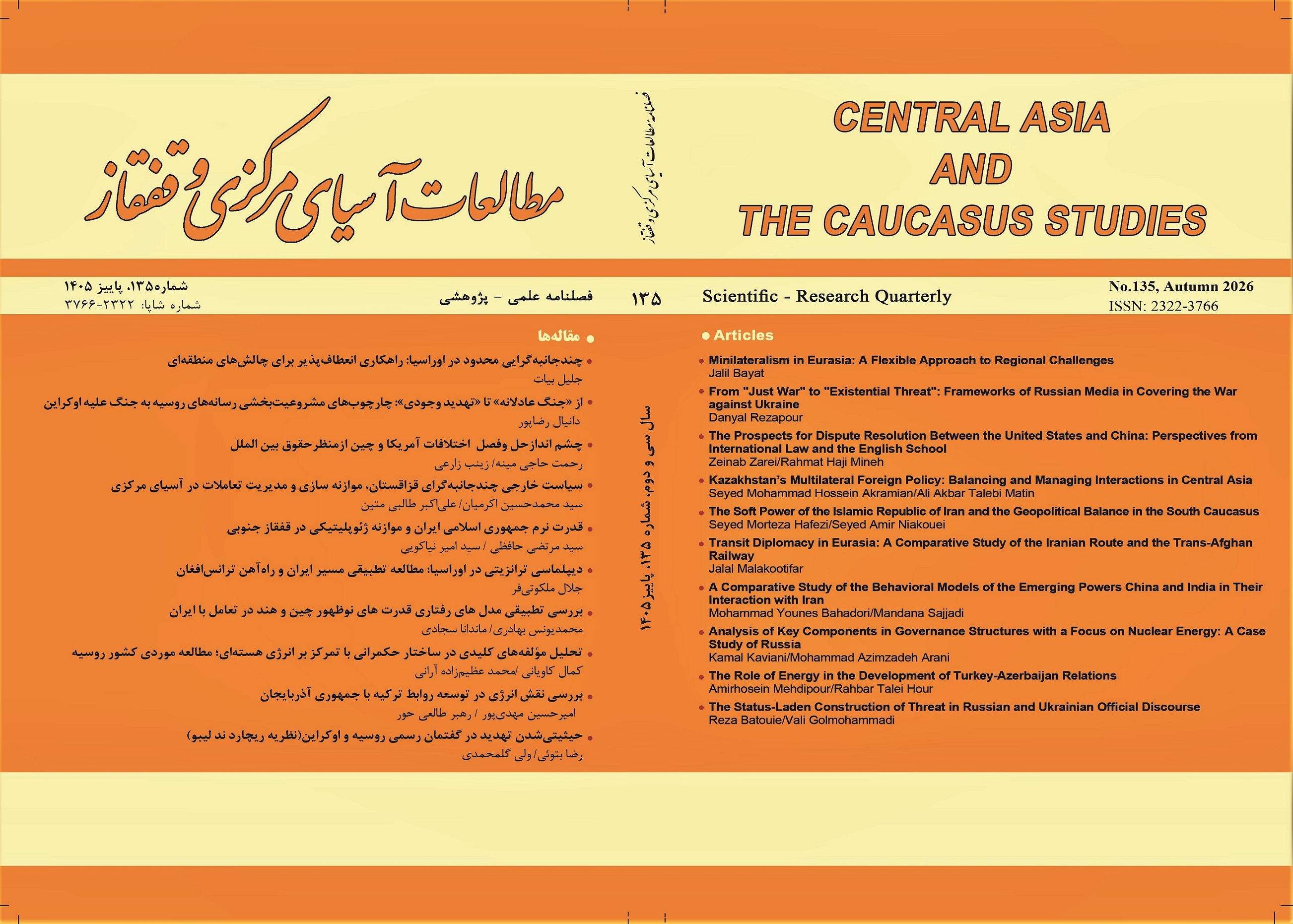
Minilateralism in Eurasia: A Flexible Mechanism for Regional Challenges

Minilateralism in Eurasia: A Flexible Mechanism for Regional Challenges

Pages 3-24

https://doi.org/10.22034/ca.2026.2081591.1962

Jalil Bayat

Abstract In recent years, the inefficiency and sluggishness of traditional multilateral institutions in Eurasia have prompted states to seek alternative, more flexible arrangements. This study analyzes agreements based on minilateralism in Eurasia and focuses on why states, alongside multilateral institutions such as the Shanghai Cooperation Organization and the Eurasian Economic Union, turn to smaller, more flexible pacts. The main research question asks why these agreements form, and the hypothesis states that they emerge primarily as complementary mechanisms to multilateral institutions, in response to the limitations and sluggishness of traditional institutions, as states seek a faster, more targeted, and less costly mechanism to address regional threats and opportunities. Adopting a descriptive-analytical approach through document review and case studies, the research examines the structural, security-geopolitical, and economic factors shaping these agreements and their differences from traditional multilateral institutions. The findings indicate that these agreements operate primarily as complementary mechanisms alongside traditional multilateral institutions and, under conditions of institutional gridlock, provide capacity for more effective and flexible coordination among member states. Finally, the article highlights the importance of these arrangements in redefining patterns of regional cooperation and in understanding future power dynamics in Eurasia.

From Just War to Existential Threat: An Analysis of the Legitimization Frameworks of Russian Media in Covering Special Military Operations Against Ukraine

From "Just War" to "Existential Threat": An Analysis of the Legitimization Frameworks of Russian Media in Covering Special Military Operations Against Ukraine

Pages 25-50

https://doi.org/10.22034/ca.2026.2081769.1965

danyal rezapour

Abstract Russia’s current policy towards Ukraine can be seen as a prominent example of regionalism and re-territorialization, based on geopolitical considerations and the redefinition of regional identities. Within this framework, the Kremlin, using a set of “signifiers” and discursive tools, especially the media, attempts to produce, represent, and solidify its preferred narrative of the conflict. The main goal of this article is to analyze the role of the Russian media in creating and disseminating the Kremlin’s official narratives as a means of legitimizing the war against Ukraine and influencing public opinion in both Russian and Ukrainian societies. By depicting the Russia-Ukraine conflict as a narrative story, the present study explains the crisis through the narrative beliefs and semantic frameworks of political leaders and elites. The media war between the two sides has been an arena of intense linguistic and discursive interactions in which language, terms, and concepts are strategically used to shape public perceptions and normalize violence. The central question of the article is how legitimizing strategies have been used in the discourse of the Russian media in 2022 to justify the “special military operation” against Ukraine, and how they relate to each other. The research hypothesis is based on the assumption that the Russian media have legitimized the discourse of the war by simultaneously employing the strategies of moral evaluation/altruism, authority and expert voice, hypothetical future, mythologizing, and rationalization; in such a way that the moral evaluation strategy,

Prospects for the Resolution of the US-China Disputes from the Perspective of International Law

Prospects for the Resolution of the US-China Disputes from the Perspective of International Law

Pages 51-78

https://doi.org/10.22034/ca.2026.2052853.1858

Rahmat Haji Mineh,, Zeinab zarei,

Abstract The growing differences between the United States of America and the People's Republic of China, as the two world superpowers, have taken on broad dimensions and encompassed various political, economic, security, and ideological arenas. These differences, which range from trade and technology disputes to human rights and regional security issues, have not only affected their bilateral relations but also challenged international stability and order. This article, by examining documents such as UN resolutions and bilateral declarations, as well as data such as economic indicators and trade statistics, and using content analysis, attempts to examine the prospects for resolving the US-China differences from the perspective of international law. The main question of the article is that given the deep and widespread differences between the US and China, is the current international legal framework capable of effectively managing and resolving these differences, or do we need new and innovative approaches in interpreting and implementing international law to adapt to the new geopolitical and economic realities of the world? The findings of the article show that international law, by providing legal frameworks and mechanisms, can play an important role in managing and reducing these tensions. Focusing on concepts such as sovereignty, non-intervention, peaceful resolution of disputes, and commitment to international treaties can provide solutions to reduce tensions and create a basis for cooperation.

Kazakhstans multilateral foreign policy, balancing and managing interactions in Central Asia

Kazakhstan's multilateral foreign policy, balancing and managing interactions in Central Asia

Pages 79-104

https://doi.org/10.22034/ca.2026.2089473.1991

seyed mohmamd hosein akramiyan, ali akbar talebi matin

Abstract Since its independence in 1990, Kazakhstan, as one of the leading countries in Central Asia, has considered following a balanced multilateral foreign policy model in international and regional interactions with Eastern powers (including China and Russia) and Western powers (including the European Union and the United States). Efforts to benefit from “multi-level and indivisible” mutual interests, pursuing “mutual procedures and principles,” as well as taking action and action at the “reciprocal” level in relations and interactions with regional and trans-regional actors are on the agenda of this country’s governance. The process of these interactions and relations can be examined in the framework of the “balanced multilateralism” model. In this paper, the levels of this relationship are examined case by case and in relation to four actors; China and Russia (in the form of Eastern actors) and the United States and the European Union (in the form of Western actors) will be explained and analyzed. The data collection method in this paper is the use of a library model and is based on a descriptive-analytical model in terms of methodology. The results of the research show that the pursuit of the "independent", "interactive", "pluralistic" and "intelligent" model of Kazakhstan's foreign policy towards Russia, China, as well as the United States and the European Union, has occurred and continued in the form of multilateral balancing.

The Soft Power of the Islamic Republic of Iran and Geopolitical Balancing in the South Caucasus

The Soft Power of the Islamic Republic of Iran and Geopolitical Balancing in the South Caucasus

Pages 105-138

https://doi.org/10.22034/ca.2026.2078247.1952

seyed morteza hafezi, seyed amir Niakoee

Abstract In recent years, soft power has emerged as one of the principal pillars of countries' foreign policies, particularly in strategically vital regions such as the South Caucasus. This article addresses the fundamental question of how the Islamic Republic of Iran can leverage its soft power capacities to counter the expansion of relations among Turkey, Israel, and the Republic of Azerbaijan in the South Caucasus—relations that, relying on security, economic, and transit linkages, have influenced the regional balance of power. The research methodology is based on content analysis of official documents, credible scholarly sources, and secondary data spanning the period from 2010 to 2024, employing the theoretical framework of Nye and Papp. The study's hypothesis posits that the targeted application of the Islamic Republic of Iran's soft power components—through enhancing regional legitimacy and persuasive power—can lead to a reduction in the geopolitical influence of the Turkey–Israel–Azerbaijan cooperation in the South Caucasus. Four key strategies are examined: preventing access to territory, wedging diplomacy, demonstrating national resolve for balancing, and delegitimizing the hegemon. The findings indicate that Iran, by capitalizing on shared cultural and historical ties, religious diplomacy, and active participation in regional institutions, can effectively resist these relations and consolidate and strengthen its position within the security architecture of the South Caucasus.

Transit Diplomacy in Eurasia: A Comparative Study of the Iranian Route and the Trans-Afghan Railway

Transit Diplomacy in Eurasia: A Comparative Study of the Iranian Route and the Trans-Afghan Railway

Pages 139-170

https://doi.org/10.22034/ca.2026.2109389.2022

Jalal Malakootifar

Abstract Landlocked Central Asian countries seek secure and cost-effective access to open waters following geopolitical shifts caused by the Ukraine crisis and the restructuring of supply chains. Using a qualitative and comparative-analytical method, this study evaluates two strategic options—the Iranian transit corridor (Chabahar and Bandar Abbas ports) and the Trans-Afghan Railway—based on four indicators: cost-time, infrastructure capacity, operational security, and political-financial sustainability. Findings indicate that Iran’s route holds short-term superiority due to existing infrastructure and operational stability; whereas the Trans-Afghan Railway, despite its shorter distance, faces security challenges in Afghanistan and financing deadlocks. These two routes serve as complementary tools for transit diversification within the theoretical frameworks of geoeconomics and complex interdependence. This study adopts a qualitative, comparative-analytical approach utilizing library resources, institutional reports (World Bank, UNESCAP, ADB), and empirical data regarding regional corridors. The study integrates Geoeconomics (Luttwak, 1990; Blackwill & Harris, 2016) and Complex Interdependence (Keohane & Nye, 2012) to explain how connectivity infrastructure acts as a tool of statecraft and how Central Asian states pursue multi-vector transit diversification to mitigate vulnerability.
Keywords: Central Asia, Geoeconomics, Transit, Chabahar Port, Trans-Afghan Railway, North-South Corridor.

A Comparative Analysis of the Behavioral Models of Emerging Powers: China and India in Their Engagement with Iran

A Comparative Analysis of the Behavioral Models of Emerging Powers: China and India in Their Engagement with Iran

Pages 171-192

https://doi.org/10.22034/ca.2026.2071434.1922

Mohammad younes bahadori, Mandana Sajjadi

Abstract Situated between the Caucasus and the Indian Ocean, the Islamic Republic of Iran holds a strategic position with the capacity to influence the Persian Gulf, the Caspian Sea, Afghanistan, and even Pakistan. This has granted Iran particular significance for emerging powers. Recognizing the dynamics of the international system, Iran has implicitly adopted a "Look to the East" strategy. Given the growing importance of China and India in global and regional developments, assessing their foreign policies toward Iran is essential to understanding prospects for future cooperation. The central question of this study is: What behavioral models have these emerging powers followed in their engagement with Iran since 2015? Using a hypothesis-testing approach based on the theoretical model of emerging powers’ behavior and conducting a comparative analysis of relevant documents, the findings reveal that both China and India have pursued pragmatic and cooperative approaches toward Iran. Their behavior is driven by factors such as economic interests, energy security, regional stability, and geopolitical considerations. Among the two, China has demonstrated a more consistent and assertive application of this behavioral model.

Analysis of Key Components in Governance Structures with a Focus on Nuclear Energy: A Case Study of Russia

Analysis of Key Components in Governance Structures with a Focus on Nuclear Energy: A Case Study of Russia

Pages 193-226

https://doi.org/10.22034/ca.2026.2080291.1969

, Kamal Kavyani, Mohammad Azimzadeh Arani

Abstract Energy governance is a set of formal and informal processes, institutions, and mechanisms that are designed and implemented with the aim of regulating the interactions of various actors in the energy supply chain. In the first part of this research, a theoretical framework has been developed through documentary and library methods. Another part of this article examines the Russian nuclear energy governance system through the “case study” method.
The findings of the article show that Russia has been able to create an appropriate separation of duties and authorities in the nuclear energy sector at three levels of policy-making, regulation, and service provision. The policy-making level is mainly in the hands of upstream government and legislative institutions such as the Federal Presidency, the State Duma, the Ministry of Energy and the Ministry of Foreign Affairs. The regulation level is also in the hands of independent regulatory bodies and specialized organizations such as the Federal Service for Ecological, Technological and Nuclear Supervision, the Ministry of Environment, the Non-Profit Market Council, and the Federal Antimonopoly Service, which are responsible for tasks such as ensuring safety, standardization, issuing licenses, regulating the market, and the tariff system. Finally, the service provision level is in the hands of State-owned Company Rosatom and its subsidiaries. Creating a three-layer structure with a clear separation of duties and authorities between policymaking, regulation and service provision is one of the most important lessons that is also recommended for the Iranian nuclear industry.

Examining the role of energy in the development of Türkiyes relations with the Republic of Azerbaijan

Examining the role of energy in the development of Türkiye's relations with the Republic of Azerbaijan

Pages 227-246

https://doi.org/10.22034/ca.2026.2061336.1889

Amirhosein mehdipour, Rahbar Taleihor

Abstract The purpose of this article is to examine the role of energy in shaping the development of relations between Turkey and the Republic of Azerbaijan. The central research question asks how energy, as a driving factor, influences the evolution of their economic, political, and security relations, and how it can direct their interactions toward deeper convergence. Based on the theoretical framework of interdependence, the study hypothesizes that enhanced cooperation in the energy sector—particularly in oil and gas trade—strengthens bilateral economic, political, and security relations between Turkey and Azerbaijan. The findings indicate that Turkey, owing to its unique geopolitical position as an energy transit hub, strives to expand its connections with neighboring countries, especially Azerbaijan. Meanwhile, Azerbaijan, rich in hydrocarbon resources, plays a key role in supplying Turkey’s energy needs and exporting its resources through Turkish routes. The continuation and deepening of such cooperation expand bilateral relations beyond energy to other strategic domains as well. This is an applied research employing a descriptive–analytical approach. Data were collected from documentary sources, official energy reports, and scholarly studies. The data were organized through descriptive and comparative analysis across five main indicators: import dependency, transit advantage, cost of interruption, bargaining power, and geopolitical effects. This approach enables an assessment of interdependence between Turkey and Azerbaijan. Given the distinct characteristics of their bilateral energy relations, the study can serve as a model for understanding broader regional and global dynamics between the two countries.

Status-Based Threat Framing in Official Russian and Ukrainian Discourse: Applying Richard Ned Lebow’s Cultural Theory of International Relations

Status-Based Threat Framing in Official Russian and Ukrainian Discourse: Applying Richard Ned Lebow’s Cultural Theory of International Relations

Pages 246-268

https://doi.org/10.22034/ca.2026.2086429.1988

vali golmohammadi, reza batouie

Abstract This study examines how official Russian and Ukrainian discourse transforms material and security-related threats into status-based threats through historical and identity narratives, thereby rendering compromise susceptible to negative framing. Drawing on qualitative document analysis and directed thematic analysis, the study examines 50 official Russian and Ukrainian documents published between 2014 and the end of 2022. Its analytical framework combines Richard Ned Lebow’s Cultural Theory of International Relations with the concepts of thymos, status, recognition, and dignity. The findings indicate that, in both discourses, historical narratives and self/other boundary-making are intertwined with claims to status and recognition; in some documents, material threats are further linked to identity, sovereignty, survival, and the collective future. Under such conditions, compromise or concession may be framed through the language of surrender, betrayal, appeasement, or humiliation, while confrontational policies are legitimized as defensive, moral, or historically necessary. Evidence relating to ceasefires, negotiations, and political settlements, however, demonstrates that this pattern is neither linear nor deterministic. Rather than identifying the causes of war or the concealed motives of decision-makers, the article analyzes the justificatory logic and meaning-making mechanisms of official discourse.

The geopolitical consequences of developments in the South Caucasus after the 2020 Karabakh war on Irans national security and interests (a case study of the Zangezzor Corridor)

The geopolitical consequences of developments in the South Caucasus after the 2020 Karabakh war on Iran's national security and interests (a case study of the Zangezzor Corridor)

Articles in Press, Accepted Manuscript, Available Online from 05 January 2026

https://doi.org/10.22034/ca.2026.733323

Zahra Ghasemi Kaldehi, Amir niakoee

Abstract The Nagorno-Karabakh crisis and the conflicts between Azerbaijan and Armenia in September 2020 and its impact on Other regional and international actors showed the geopolitical importance of this region and the effects of these crises on Iran, therefore, the present research is aimed at answering this question: What threats will the Zangez-Zor Corridor construction program have against the interests of the Islamic Republic of Iran? And in this regard, using the theory of regional security, the hypothesis has been proposed that the creation of Zangezzor Corridor in the territory of Armenia, based on the plans announced by the Republic of Azerbaijan-Turkey axis, can change the regional balance of power to the detriment of the Islamic Republic of Iran; Therefore, the advancement of this project is considered a security threat against the geopolitical and economic interests of the Islamic Republic of Iran, the most important of which are: the possibility of changing the geopolitical borders by blocking the land border between Iran and Armenia; The possibility of Armenia's convergence with the Western bloc and the intensification of the strategic isolation of the Islamic Republic of Iran; Reducing Iran's transit advantages in the North-South corridor; increasing Turkish influence in the region; jeopardizing national sovereignty and territorial integrity by advancing the Pan-Turkic plan and reviving Azari ethnocentrism; Strengthening the presence of NATO, Israel and Russia in the northern borders of the country. Also, descriptive analytical method has been used in this research and library information collection method has been used.

The Nation Branding of Russia in Iran: A Case Study of Sputnik during the Twelve-Day Imposed War

The Nation Branding of Russia in Iran: A Case Study of Sputnik during the Twelve-Day Imposed War

Articles in Press, Accepted Manuscript, Available Online from 05 January 2026

https://doi.org/10.22034/ca.2026.2069690.1914

Sajad ImaniPour

Abstract In the era of globalization, national branding at the international level carries great significance, as it can create a strategic competitive advantage in interactions with other states. Sputnik news agency, functioning as one of the instruments of Russia’s public diplomacy on the international stage and operating in multiple languages, has attracted a substantial Persian-speaking audience to its Persian-language platforms. In this context, the twelve-day war of aggression against Iran provided a suitable opportunity for Sputnik to pursue activities aimed at promoting Russia’s national brand and influencing Iranian public opinion in that direction. Using content analysis combined with thematic-network analysis, this study sought to answer the question: what public-diplomacy strategies did the Telegram channel of the state media outlet Sputnik Iran employ for Russia’s national branding among Persian-speaking audiences during the period of the war? Ultimately, five overarching themes related to Russia’s branding were identified in the messages of this state channel: Russia as civilized; Russia as rational and moderate; Russia’s power; the robust relations between Iran and Russia; and the West’s efforts to preserve its hegemony. These pervasive themes are interpreted as part of Russia’s “othering” of the West and the United States and as an attempt to reinforce Russia’s soft power.

Geoeconomics of Central Asia’s Critical Minerals: Corridor Competition and Iran’s Position

Geoeconomics of Central Asia’s Critical Minerals: Corridor Competition and Iran’s Position

Articles in Press, Accepted Manuscript, Available Online from 13 September 2026

https://doi.org/10.22034/ca.2026.2066369.1902

Zahra Mohammadi

Abstract Critical minerals have become a central concern of supply security, yet in landlocked Central Asia the geoeconomic value of mineral resources depends not only on extraction and processing but also on the ability to move output through reliable, substitutable, and financeable corridors. This article explains how competition over critical minerals extends into corridor competition and assesses the conditions under which Iran can convert locational advantage into operational centrality. It develops an analytical framework linking geoeconomic instruments, networked interdependence, regional agency, corridor performance, transaction risk, and traceability, and distinguishes four stages: asset, capacity, capability, and realized flow. Empirically, the study combines structured documentary comparison, multi-source secondary data, process tracing, and an embedded case study of Chabahar over 2021–2026. The findings show that mineral competition does not create corridor rivalry from zero; rather, it raises the strategic value of routes able to attract and retain flows under acceptable levels of cost, time, reliability, legal-financial risk, and informational traceability. Central Asian agency also depends on usable, not merely announced, alternatives. Iran possesses a genuine southern option, but available evidence does not support claims of established centrality. Its position is better understood as conditional centrality: geography and infrastructure create entry potential, while sustained mineral flows require measurable improvements in border performance, transaction conditions, multimodal connectivity, and end-to-end traceability.

The Role of the Armenian Diaspora in the Foreign Relations of the Republic of Armenia (2018 - 2024)

The Role of the Armenian Diaspora in the Foreign Relations of the Republic of Armenia (2018 - 2024)

Articles in Press, Accepted Manuscript, Available Online from 13 September 2026

https://doi.org/10.22034/ca.2026.2075736.1940

Mohmmad Hossein Masoumzadeh

Abstract The present research analyzes the geopolitical developments in the South Caucasus and their impact on the dynamics of relations between Nikol Pashinyan’s government and the Armenian diaspora from 2018 to 2024. The central issue is to explain why and how the diaspora’s status in Yerevan’s foreign policy equations has shifted. Using a qualitative method and a documentary-analytical approach within the framework of diaspora diplomacy, this article argues that following the Second Nagorno-Karabakh War and the fall of Artsakh, the political influence of the diaspora (especially in France and the US) has been reduced from a “strategic partner” to a “financial and humanitarian supporter.” Findings indicate that while Armenian lobbies have been successful in public diplomacy and resource mobilization, they face structural limitations in influencing macro-security decisions. Ultimately, to ensure national security and normalize relations with neighbors, the Armenian government has limited the diaspora’s political agency, shifting its strategic paradigm from “diaspora-centric idealism” to “state-centric realism.”

ISIL Terrorist Cells’ Network in Central Asia

ISIL Terrorist Cells’ Network in Central Asia

Volume 21, Issue 92, Autumn 2016, Pages 29-63

Mohammad Reza Dehshiri, Shahin Jozani Kohan

Abstract Central Asia constitutes an area of interest for ISIL in order to create a Transnational Advocacy Network of terrorist cells with the aim to undertake terrorist actions in the battleground of Syria and Iraq. ISIL seeks to utilize cyberspace and new communication tools such as social networks in particular Khalifabook - a self-made website - to recruit and train people of the region and create a network of terrorist cells.
This paper aims to evaluate the performance of ISIL in cyberspace and asses the employment of a network of terrorist cells in Central Asia. In this regard, the following question arises: how has ISIS attempted to create networks of terrorist cells in Central Asia? The authors believe that through propagating its messages in virtual space, ISIL seeks to recruit and train militias and establish a network of terrorist cells in Central Asia.
After explaining ISIS’ new communication tools in the context of cyberspace, its goals and objectives in the virtual environment with the aim to recruit and train new forces as well as to create terrorist cells in Central Asia, this paper presents possible strategies in order to confront ISIL in this region.
 

Geopolitics of American and Chinese Silk Road Narratives in Central Asia

Geopolitics of American and Chinese Silk Road Narratives in Central Asia

Volume 23, Issue 99, Winter 2018, Pages 1-25

Mandana Tishehyar, Mojtaba Touiserkani

Abstract Some international actors have sought to revive and benefit from the symbolic power of the term “Silk Road” in recent years. China launched the "One Belt One Road" initiative in 2013 and presented the Silk Road Economic Belt with Central Asia as its main route. Earlier in 2011, the United States officially used the romantic term of the Silk Road to define its foreign policy towards Central Asia. However, the American narrative of the Silk Road distinguishes from its Chinese narrative. This study is aimed to compare geopolitical discourses on which the American and Chinese narratives of the New Silk Road in Central Asia rely. This literature addresses the following question: “which geopolitical discourse shapes the American and Chinese narratives of the New Silk Road?” In spite of US resorting to the Silk Road metaphor, its New Silk Road map is based on redefining the geopolitics of domination in Central Asia, while China's Silk Road Economic Belt is based on a critical geopolitical idea, and recognizes Central Asian Republics as influential geopolitical actors. 

Belt – Road Initiative: Fortifier of Heartland Theory

Belt – Road Initiative: Fortifier of Heartland Theory

Volume 22, Issue 96, Winter 2017, Pages 163-188

Enayatollah Yazdani, Ali Omidi, Parisa ShahMohammadi

Abstract Eurasia which is called as the heart of world politics in Heartland Theory is facing such wide and diverse developments in the light of Belt – Road Initiative that would add to its significance.
The Heartland Theory which is also called as Mackinderian Philosophy placed the pivot in the center of the planet, which includes the river basins of the Volga, Yenisey, Amu Draya, Syr Draya, and two seas the Caspian and the Aral. This theory put emphasis on the centrality of the Eurasian region. Mackinder stated that in the context of the global geopolitical processes, the Eurasian continent is found in the center of the world politics. Mackinder believes that Heartland would remain as the geographical pivot of history for all the times, but some rival theories and criticisms had been challenging its accuracy and durability.
In order to answer the question that how the Belt – Road Initiative could re -highlight Eurasia as Heartland, explores the following hypothesis: Belt – Road Initiative fortifies the potential nature of Heartland Theory. Using explanatory – analyzing research method, the authors try to tell why the research findings provide an answer to the research question.

Türkiye`s Role in Iran and the Republic of Azerbaijan`s Relations

Türkiye`s Role in Iran and the Republic of Azerbaijan`s Relations

Volume 30, Issue 126, Summer 2024, Pages 145-166

Rahbar Talei hur, Amir Hossein Mehdipour

Abstract In the Caucasus disputes, some regional powers such as Turkey seek to play a role in the equations of this region. In line with the balance of power with Iran in the Caucasus region, Turkey is trying to seriously pursue its presence in support of Baku, which can impact the relations between the Islamic Republic of Iran and the Republic of Azerbaijan. Therefore, the main goal of this article is to investigate the role of Turkey in the security of the relations between the Islamic Republic of Iran and the Republic of Azerbaijan, and the research question can be expressed as what role Turkey played in the security of the relations between Iran and Azerbaijan? In response to the research question, using the theoretical framework of the Copenhagen school, a hypothesis is proposed as follows: Turkey, by using pan-Turkic policies, military cooperation, arms support, and intelligence support from the Republic of Azerbaijan and facilitating the presence of Takfiri forces in the region, the security of relations between Iran and Azerbaijan has played a role. The research findings show that Turkey's most important goal in the Caucasus is long-term political, economic, and security presence and influence, which it pursues with the cooperation of Azerbaijan. In addition to the linguistic, ethnic, and cultural links between the Republic of Azerbaijan and Türkiye, a combination of various political, defense, and economic factors has also been affected.

The Implications of Russia and Ukraine War (2022) on the International Economy

The Implications of Russia and Ukraine War (2022) on the International Economy

Volume 28, Issue 118, Summer 2022, Pages 37-60

Hamid ِDorj

Abstract Russia's massive invasion of Ukraine in February 2022 and the severe financial sanctions imposed against Moscow have not only had an economic impact on Russia; but, the consequence of this crisis has also affected the international economy, including America and Europe’s markets. The inflation caused by the Ukraine crisis, which has currently disrupted most of the world's economies, including the United States and Europe, is constantly increasing due to the sharp increase in the prices of oil, gas, industrial and agricultural products. This article tries to examine the economic impact of the war between Russia and Ukraine in 2022 on the key players of the global economy, especially the United States and Europe, which have imposed severe financial sanctions against Russia. Therefore, the main question of this research is: What effect will the Russia – Ukraine war have on the international economy, especially for the U.S. and Europe?
The hypothesis of the research is that given the fact that the conflict in Ukraine has the political and military dimensions, the leaders of these countries have prioritized the political issues over the economic issues in their decision making process to address this crisis. This has caused the economy to be affected again by high politics issues and faced stagnation and increase in global prices which once was considered as a low politics during the Cold War and then, it became more relevant in the decision-making process of governments after the Cold War.
This paper has applied the descriptive-analytical method to analyze the data.

New Spice Route: A Regional Rival for New Silk Road

New Spice Route: A Regional Rival for New Silk Road

Volume 25, Issue 105, Spring 2019, Pages 1-38

Mojtaba Touioserkani

Abstract Introducing of the Belt - Road Initiative, China is being considered as a prior actor pursuing regional ties and a connectivities between Asia and Europe. However, China's presence in this area seems not to be the only one and there is a high competition for building infrastructures across Eurasia. India is one of the Asian giant who is slowly entering the huge infrastructure projects in this continent and seeks the revival of International North-South Transportation Corridor (INSTC). The author argues that the New Spice Route is a metaphor that narrates the revival of rivalry between India and China to dominate the routes of transporting goods and energy. The present literature is to explore the main goals and motivations of India for revitalizing International North-South Transportation Corridor in the direction of New Spice Route that was established around fifteen years ago. Using descriptive-analytical method and library and documentary resources, under the framework of the theory of structural realism, the author tries to show that India's attempt to reconstruct INSTC and to promote the New Spice Route primarily focuses on security objectives and incentives, including a change of status quo in Jammu and Kashmir; stripping China's geopolitical and geostrategic opportunities in the Indian Ocean Region (IOR); establishing a gap between Pakistan and its neighbors, in particular with Afghanistan; and making geopolitical ties with its new partners in Central Asia and South Caucasus via Iran.

Russia – India – China Triangle and the Possibility of a Cooperation Network

Russia – India – China Triangle and the Possibility of a Cooperation Network

Volume 24, Issue 101, Summer 2018, Pages 117-148

Mohammdreza Jahangiri, Khosro Vafaei Sa´di

Abstract The Russia – India – China Triangle is one of the first mechanisms that were used to encounter the US centered international order by the eastern powers which brought along the SCO and BRICS. Russia, India and China’s foreign ministers troika is actually an attempt for making a cooperation network among revisionist powers. Given the bilateral, trilateral and multilateral relations between the three mentioned countries, the question is whether such a goal is possible or not. The article’s achievement proves that although having relative potentialities and strong motivations for changing the US centered international order, the Russia – India – China Triangle is not capable of achieving the goal in the present situation. That is rooted in their diverse perception about the nature of this change and the position of each three country in the future of such a new order.  Therefore strengthening the perspective of a change in international order is assessed as a positive measure for these players. Using an explanatory - analyzing method, the literature tries to find out the inefficiency causes in mechanisms of Russia – India – China Triangle.

Greater Central Asia, from Myth to Reality

Greater Central Asia, from Myth to Reality

Volume 21, Issue 89, Spring 2016, Pages 1-31

Seyed Davoud Aghaei, Ehsan Fallahi

Abstract Region word is mutant concept in political term, That’s mean, predefined regions will altered over the time with Political climate. Central Asia in cold war period was a part of Soviet Union.  After the collapse of the Soviet Union  five republics became independent in this area. During the first half of Nineties decade, Most of researchers were believing that Central Asia, Caucasus, Baltic States & Eastern Europe has not  Separate identities. But Gradually  in  the second half of this decade Central Asia Studied as distinct region. Expanding the Central Asia borders was raised coincide with occurrence the New Great Game in this region. Greater Central Asia plan is Consequence of this Process. Up to now Different interpretations of Greater Central Asia have been presented. This Article follows the American Greater Central Asia narrative and tries to answer the below questions. Whether Greater Central Asia  can be implementation? What are the forwarded Restrictions of this project? What is the main aftermath of Greater Central Asia plan? “The main Consequence of Greater Central Asia plan is reduces China & Russia influence in region. Greater Central Asia plan have faced with complex of security barriers. China & Russia’s Opposition will Prevent Implementation of this plan.” We will examine above  hypothesis With applying the Regional Security Complex theory.


Keywords Cloud